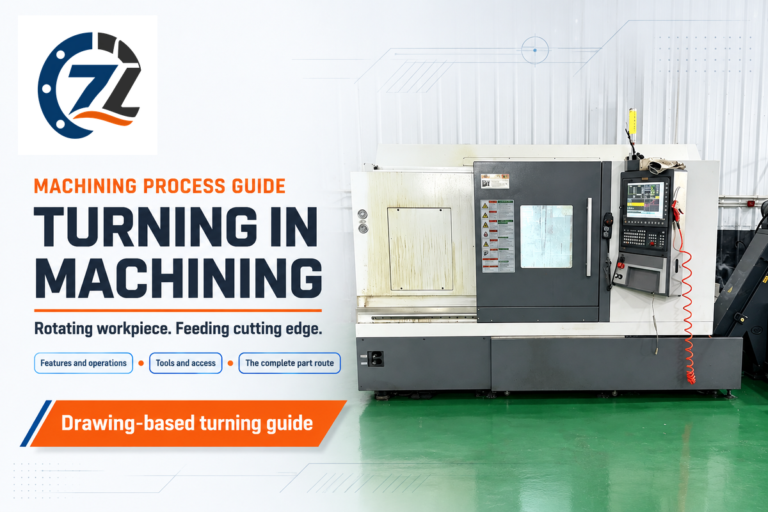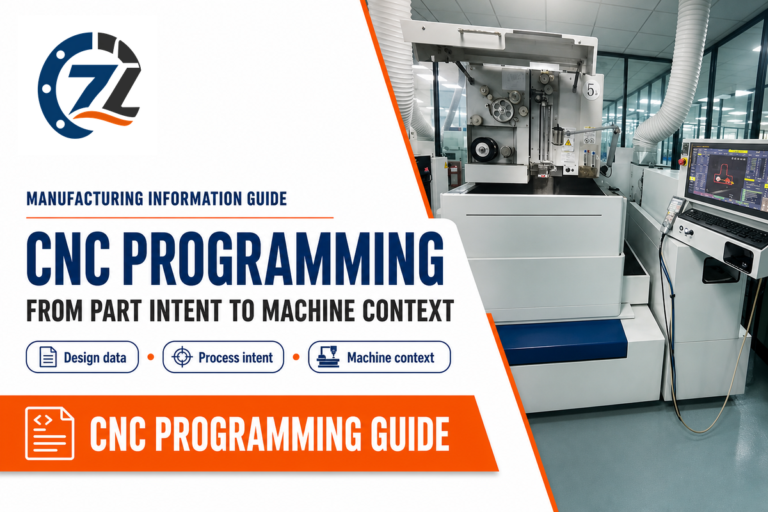


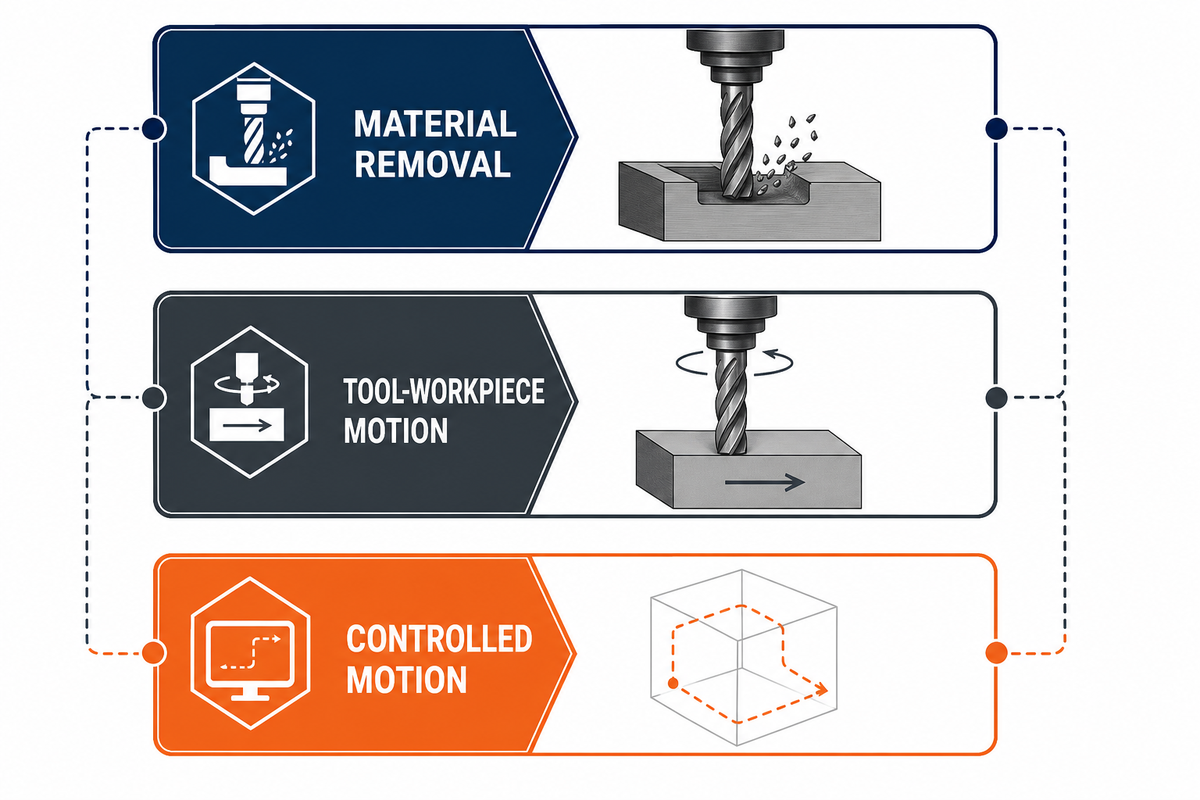
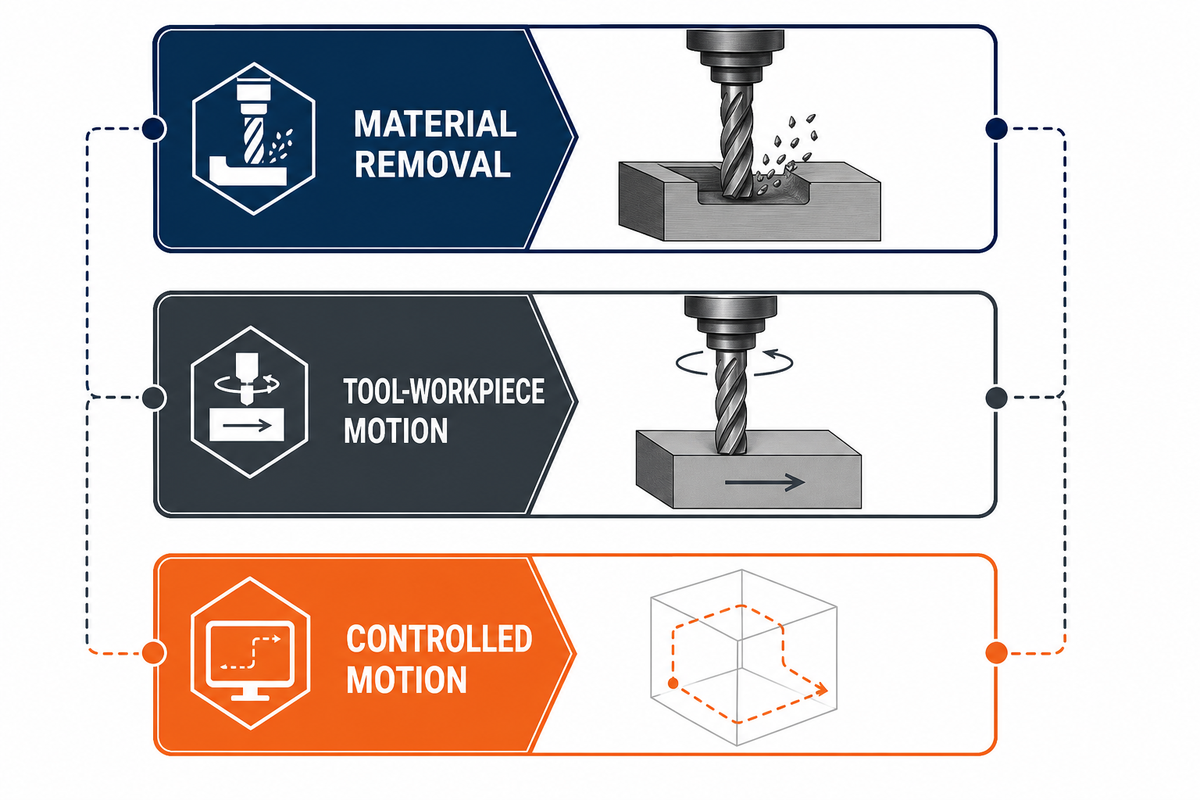
Machining processes are often labeled to convey as much information as possible in only a few words. Names such as ‘turning’, ‘grinding’, ‘EDM’, or ‘CNC machining’ can refer to different layers of the manufacturing conversation, including material removal, tool/workpiece motion, and controlled motion. This guide separates these layers so that the name does not need to select the process; it only needs to be easier to read.
Short answer: machining processes are material-removal methods. They can be classified into processes that remove material using a defined tool edge, processes that use multiple abrasive grains without a defined edge, and processes using electrical, chemical, thermal, or other energy-based interactions. Process names could describe the method of relative motion, the method of control, or the mechanism of material removal. As such, the name should be interpreted in context.
This terminology-and-mechanism guide provides a reliable way to interpret common, everyday labels for engineers, buyers, students, and technical readers. It does not provide a process-selection guide, a part-specific decision sequence, or an implied recommendation about how a particular component ought to be made. Making those decisions is beyond the intended scope of this guide and usually requires application-specific knowledge that a general term cannot supply.
Why Machining Language Overlaps
The evolution of manufacturing language was in concert with workshops and machine tools, often necessitating the use of terms at different levels. Broad process families may contain related operations that differ in their exact tool motions, control modes, or material-removal mechanisms when described at a more specific vocabulary layer. An operation may be achieved on more than one type of machine. Further, a control term may describe the motion of different axes without describing the mechanism of material removal.
NIST groups machining processes based on how material is removed. NIST identifies cutting processes with defined geometry, abrasive processes with undefined geometry, and methods that use electrical, chemical, optical, or hydrodynamic energy. This report is used in this article as a technical classification frame and not as a statement of current practices or as a universal naming recommendation. It’s worth considering, as it asks a straightforward question: how is material being removed? NIST’s machining-process discussion provides the technical background for this distinction.
In everyday language, processes can be described very generally. In a shop, a process may be called CNC, whereas a book may refer to a process as milling. Neither is incorrect, but there’s a problem if a single name is expected to answer all the questions.
Four Terms Worth Keeping Separate
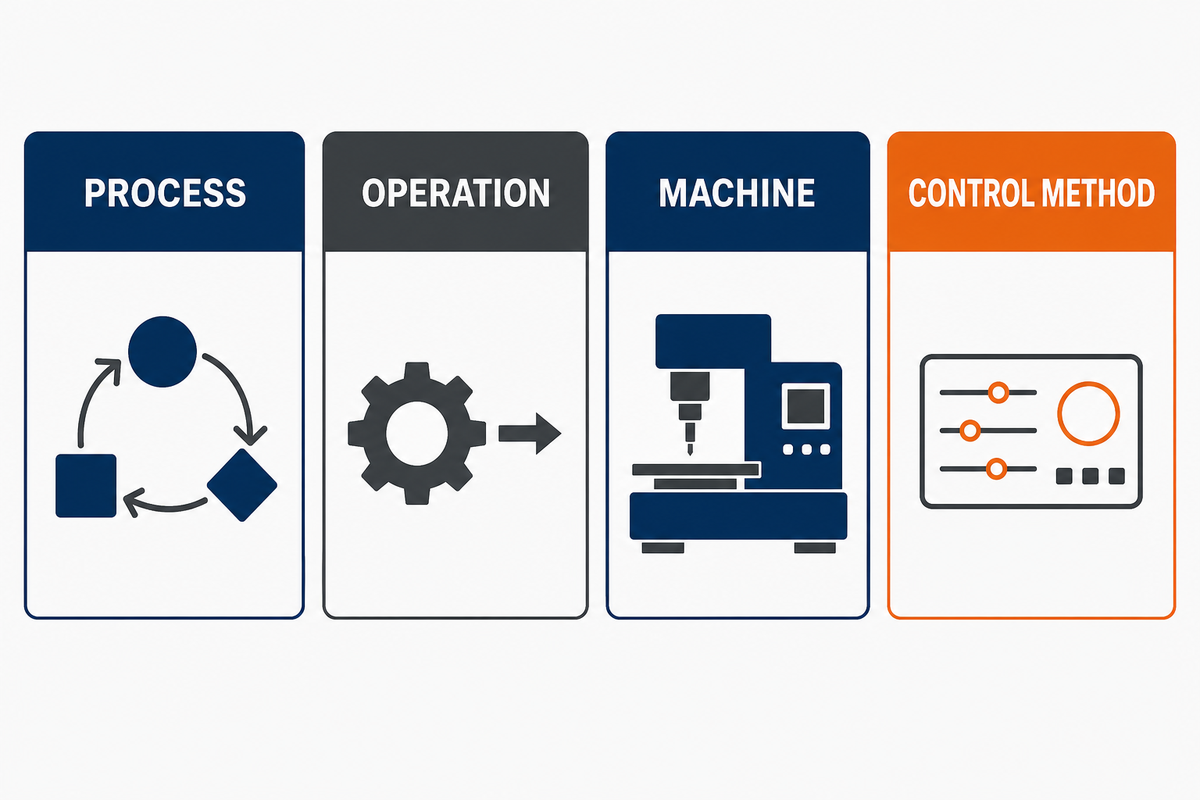
Prior to evaluating names, each level should be given its own unique responsibility. Together, these levels provide a useful reading frame for untangling labels without treating their order, prominence, or place in a textbook list as a selection rule. They aren’t intended to replace an established standard or a shop’s documented terms.
| Term | What it usually names | Example of the boundary |
|---|---|---|
| Process | Material-removal method or family defined by its central interaction. | Electrical-discharge machining names an electrical-thermal removal process. |
| Operation | A recognizable act performed within a manufacturing sequence. | Turning or drilling operations describe particular machining actions. |
| Machine | The equipment that delivers and constrains the action. | Lathes, machining centers, grinders, and wire EDM machines are equipment, not automatically full process descriptions. |
| Control method | How commanded motion and machine functions are coordinated. | CNC can control milling, turning, grinding, and other operations; it is not itself one removal mechanism. |
This second table is a vocabulary reading aid. It separates questions that a term can clarify from questions that still need part-specific documentation; it is not a process-selection sequence.
| Term | Question it can clarify | Question it still cannot settle |
|---|---|---|
| Material removal | What is being changed at the workpiece. | Which machine, tool, or setup is involved. |
| Workpiece | Which body is acted on. | Removal mechanism or operation name. |
| Tooling | What may contact or act on the workpiece. | Complete process definition. |
| Cutting edge | Whether a defined-edge cutting interaction is being described. | All motion, control, or inspection details. |
| Abrasive grain | Whether abrasive interaction is part of the description. | Any particular finish or dimensional outcome. |
| Relative motion | How named elements move with respect to each other. | Material-removal mechanism by itself. |
| Axis motion | How controlled movement may be described. | Process family or tool geometry. |
| Workholding | How a workpiece may be constrained for an operation. | Removal method or final result. |
| Inspection | How a stated result may be checked. | Which process created the feature. |
In some technical contexts, grinding is a finishing operation and is discussed while considering surface finish. Grinding terminology needs context in order to ascertain its meaning. NIST terminology reference.
MIT’s machining lecture uses simple examples of subtractive manufacturing methods like turning, milling, drilling, and grinding. No single term has one fixed home, because textbook classification, shop-floor speech, machine documentation, and a controller label may organize the same operation differently. Readers can ask which ‘box’ the speaker is using to decide if two terms are synonyms. For that, take a look at MIT’s lecture on machining, in the usual context of ‘conventional manufacturing’.
Reading a Process Name: Mechanism, Motion, and Concept
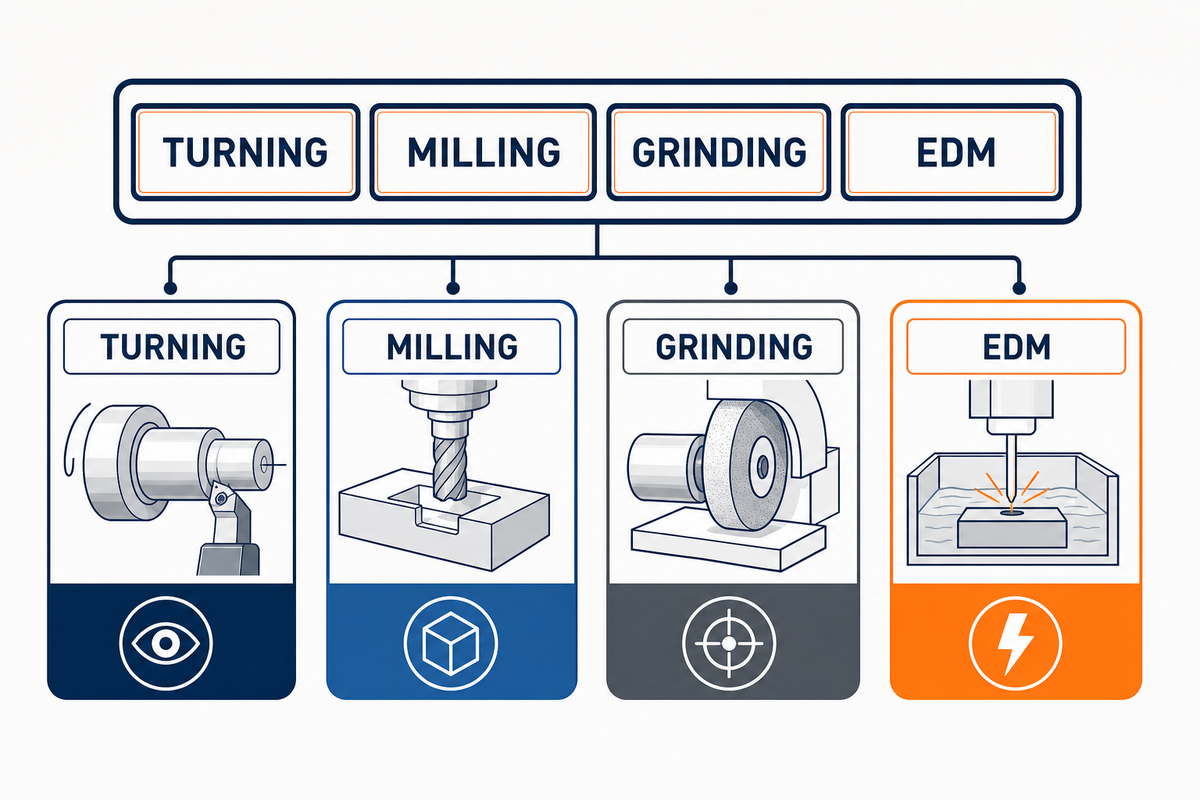
Even very short names can carry significant information. For example, ‘turning’ describes a relative motion in which the workpiece rotates against a cutting tool. ‘Milling’, in contrast, suggests rotating cutting tools. ‘Grinding’, of course, suggests an abrasive tool. ‘EDM’ suggests an electrical-discharge mechanism. In everyday discussion, a name can also suggest a tool, but that is not a complete definition, because the same word may be used for an operation, a machine, a control approach, or the material-removal interaction itself, depending on the speaker’s intended layer of description. For example, one metal manufacturing process can include a machining operation such as one of several milling operations. A milling machine or drill bit names equipment or tooling in that conversation, not a universal synonym for the process itself. For a separate discussion of cutting tools and holders, see the tooling context. MIT machining terminology context.
| Process type | Primary reading cue | What the label alone does not settle |
|---|---|---|
| Turning | Relative rotational motion and a defined cutting edge. | Exact tool form, setup, workholding, inspection, or result. |
| Milling | A rotating, defined-edge cutter and programmed relative motion. | Complete path strategy or part-specific accessibility. |
| Drilling | An axial cutting action commonly associated with a rotating drill. | Exact hole-making sequence, tool geometry, or final verification method. |
| Boring | An operation that works from an existing opening with a controlled cutting action. | Originating operation, tool arrangement, or any particular result. |
| Reaming | A named hole-finishing operation with a multi-edge tool. | All preceding work or the complete workpiece condition. |
| Grinding | Abrasive action through many grains whose edges are not geometrically defined. | One universal surface or dimensional outcome. |
| Honing | Abrasive action associated with a controlled finishing movement. | Complete measurement basis or application-specific requirement. |
| EDM | Electrical discharges that create thermal erosion at the interaction zone. | A blanket statement about every material or every EDM variant. |
| Wire EDM | An EDM configuration in which a moving wire electrode participates in the discharge process. | Whole machine setup, material condition, or geometry of a specific workpiece. |
Language that describes motion and control needs care because it can suggest more than what’s actually described. Motion and control describe an action in space over time, but they don’t specify all physical phenomena occurring at the interface. Two operations may move relative to one another along the same axis, and each operation may engage a different tool or a different mechanism of removal. Similarly, two machines may be described in relative motion at different levels of detail. Relative motion is therefore an important aspect of naming, not an avoidance of the removal mechanism.
This activity isn’t about answering a question to rank the components; it is about interpreting terminology before any actual geometry, material, process constraints, or application requirements can be assessed. Labels can refer to mechanisms or motion while leaving many details unspoken, including tool geometry, workholding, the exact path strategy, inspection basis, material condition, and any application-specific requirement that a particular part or assembly would still need. Treating a label as a complete manufacturing plan is less accurate than treating it as a compact technical clue.
Three Broad Families of Material Removal
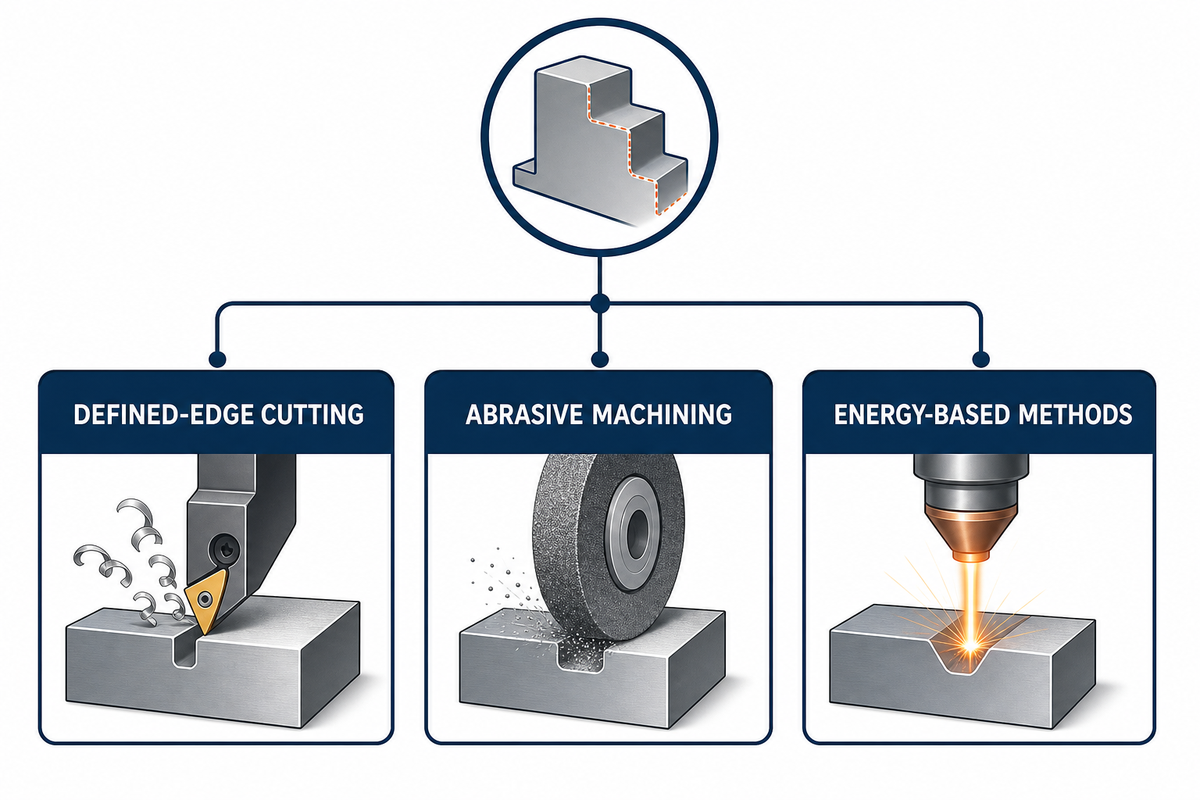
One useful illustration divides machining according to the primary material removal mechanism. Those boundaries are useful but not absolute: an engineered process may combine mechanisms, and a family label does not eliminate the need for clear technical context. NIST classification context.
Defined-edge cutting
Material is removed by a cutting edge with intentionally specified geometry. Turning, milling, and drilling are common operation names associated with this family.
Abrasive machining
Material is removed through many abrasive grains. Their active edges aren’t geometrically defined in the same way as a single-point or formed cutting tool; this is still material removal, and abrasive action can form chips.
Energy-based methods
Removal is associated with electrical, chemical, thermal, optical, or other energy-mediated interactions rather than a conventional cutting edge alone.
NIST’s classification avoids an overly simple contrast between “ordinary machining” and everything else. Abrasive work, for example, deserves its own description because the contact and edge geometry differ; that difference does not place it outside material removal.
EDM as a Boundary Case for Careful Language
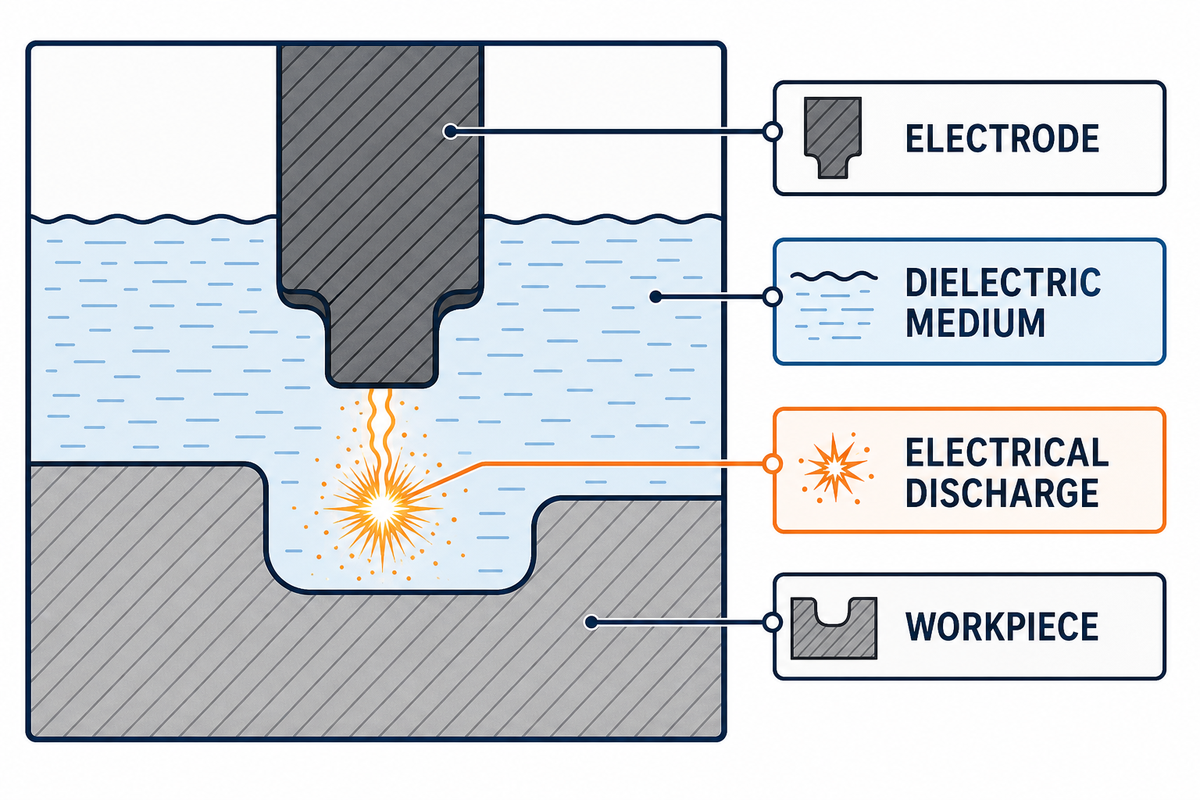
The name of a process should be read through its mechanism. In conventional EDM, electrical discharges repeat between the electrode and workpiece in a dielectric medium. An electrical discharge occurs between an electrode and the workpiece in a dielectric medium. Each discharge triggers the localized melting and evaporation of material. At the University of Cincinnati, the micro- and nano-manufacturing laboratory describes this conversion of electrical energy to thermal energy and the repeated spark mechanism. Read the University of Cincinnati overview.
That mechanism also creates a real boundary: conventional EDM normally needs a conductive path through the workpiece. A peer-reviewed EDM review likewise describes conductivity as a standard requirement for the workpiece and tool. The review article is useful because it connects the familiar name to the physical requirement rather than presenting EDM as a generic shortcut.
Research and assisted-process exceptions do exist, for example, in the case of research on nonconductive ceramics where an EDM-related removal process was enabled either by the addition of conductive additives or by applying assisting-electrode techniques. Although these are considered qualified techniques, they don’t indicate that conventional EDM is capable of removing all nonconductive materials. The ceramics review makes this point.
Why Control Terms Travel Across Process Families
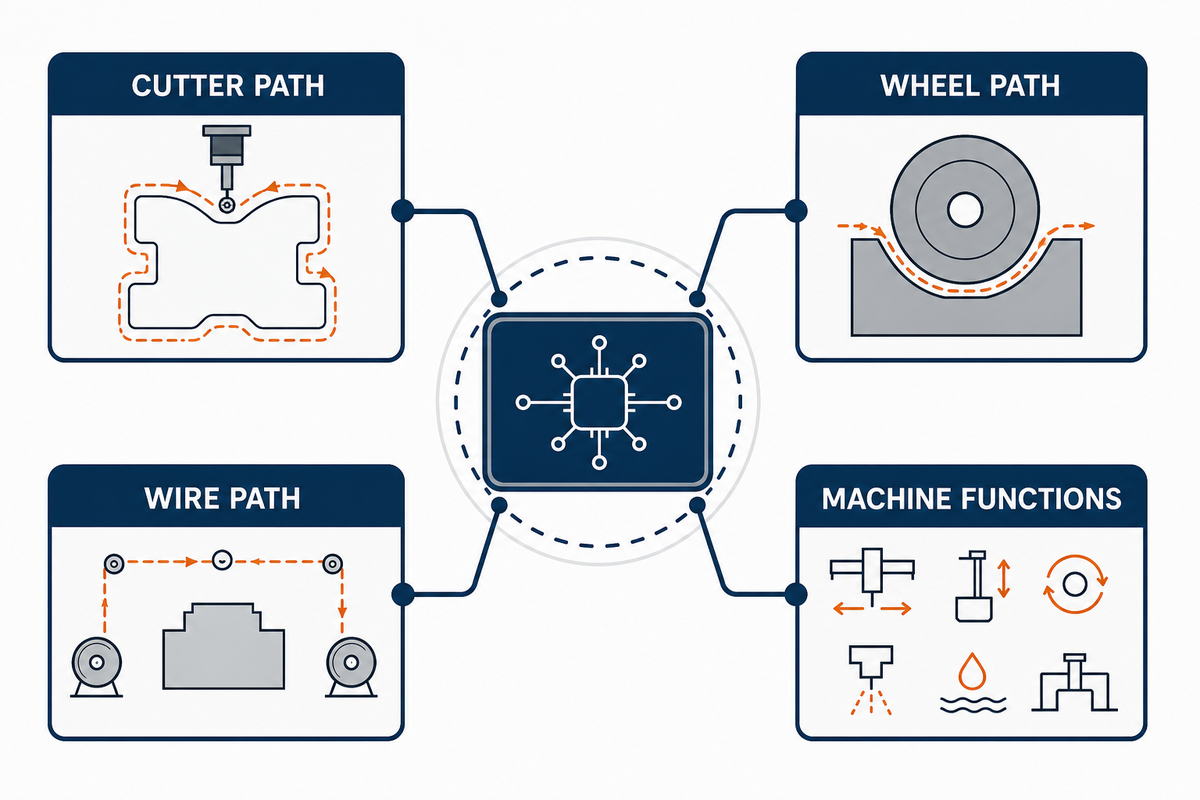
Control vocabulary moves easily across machinery because control answers a different question from mechanism. In the language used in this guide, numerical control is a control descriptor that can coordinate a cutter path, a wheel path, a wire path, or machine functions associated with an energy-based process. That portability is precisely why “CNC” is useful as an umbrella expression and incomplete as a mechanism description. NIST terminology reference.
The same thing applies to other words such as automated, programmed, or multi-axis. They may provide useful context about command and coordination. They don’t provide answers to whether a tool has a defined edge, or whether abrasive grains or electrical discharge are involved in the removal process. Reading a control term as a control term prevents a common category mistake without diminishing its practical relevance in manufacturing. For a separate discussion of program terminology, see the programming context.
The 3-Layer Mechanism-Motion-Control Triad
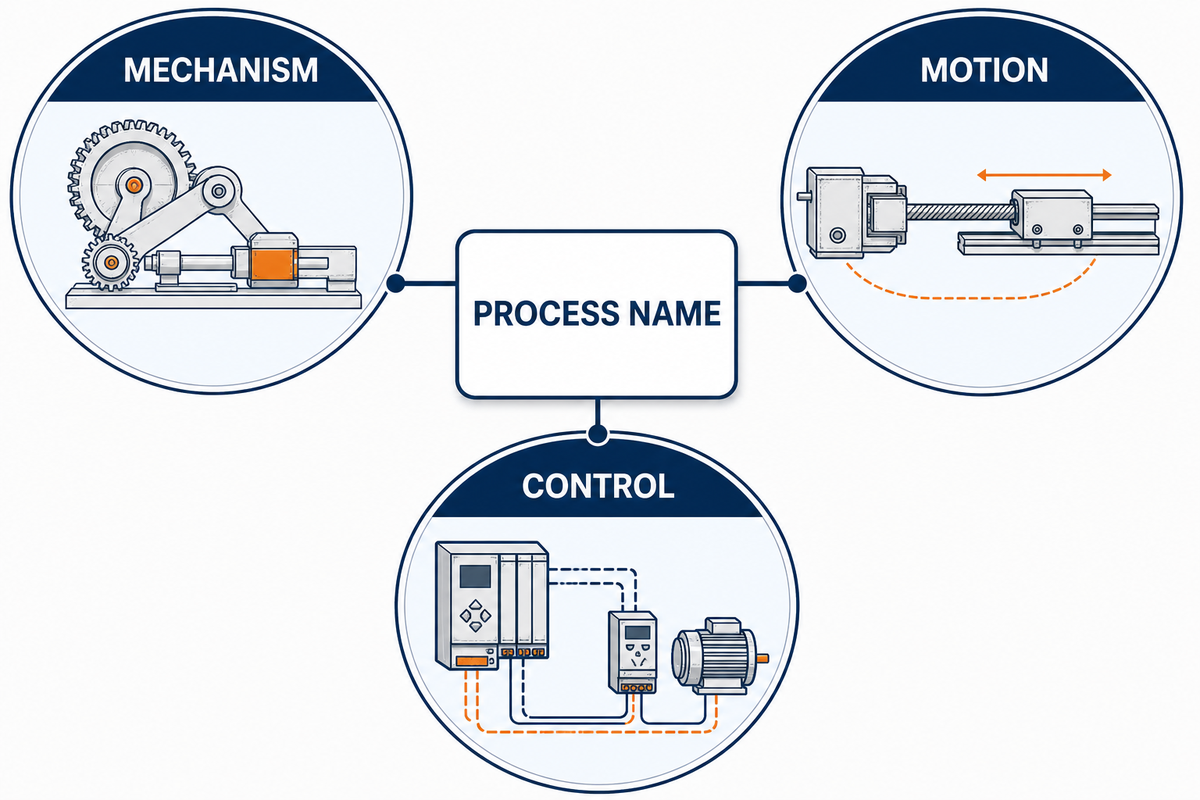
To help manage overlapping terminology, this document will use the 3-Layer Mechanism-Motion-Control Triad as an editorial tool. It is a guide-local construct, not an industry standard or a process-ranking model. It’s also not a substitute for application engineering. NIST material used as reference elsewhere establishes vocabulary; it does not define this Triad. Its value is limited, but the Triad stops a single label from having to represent multiple concepts. NIST vocabulary context.
- Mechanism: What physical interaction is primarily associated with removal, defined-edge cutting, abrasive contact, electrical discharge, chemical action, or another energy-mediated interaction?
- Motion: Which relative movements make the interaction possible, rotation, feed, reciprocation, wire travel, orbital movement, or another coordinated path?
- Control: How are those movements and machine functions commanded, manual control, numerical control, adaptive logic, or another control arrangement?
Each label emphasizes one layer over the others. The Triad is not a claim that every process has one fixed mechanism; hybrid labels may involve more than one mechanism or interaction. It is simply a way to ask better questions about the meaning already present in the name. “CNC” emphasizes control; “Grinding” emphasizes the abrasive mechanism; “Turning” evokes a familiar motion relationship.
If a reader sees “CNC grinding,” they can imagine “CNC abrasive machining” and then, “Grinding, the family of motions and equipment.” “CNC” means a certain layer of control. This doesn’t describe the process in detail. It means the phrase can be interpreted as a set of mechanism, motion, and control layers rather than as one indivisible process.
What a Process Name Still Cannot Settle
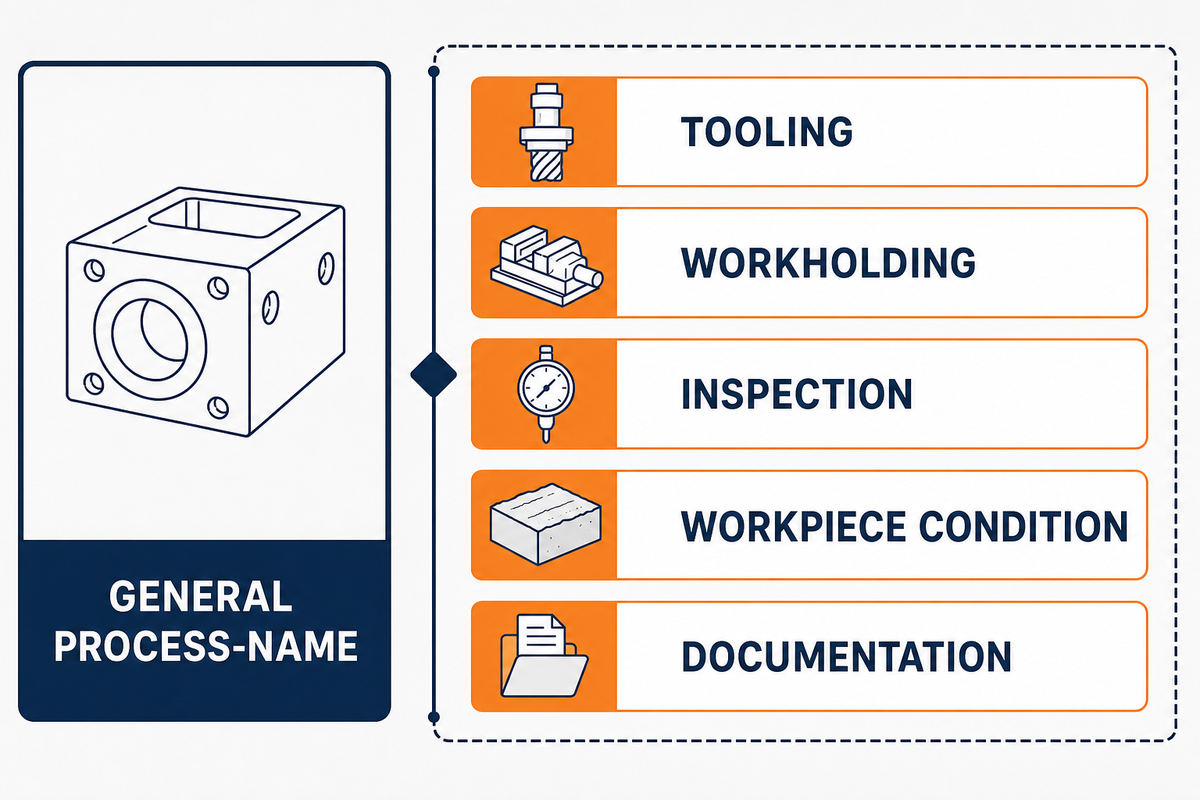
A process name can communicate limited mechanism or motion context, but it can’t settle the exact tool, workholding, access, inspection approach, workpiece condition, or feasibility of a specific job. It also cannot substitute for documentation that governs a particular part or assembly.
It cannot tell a reader whether documentation calls for a 0.01 mm dimension, a 5 μm condition, a 1,000 rpm motion, a 20 °C environment, a 0.1 MPa value, a 1 sec pulse, a 50 Hz frequency, or a 1 kW setting. Those examples illustrate units a technical document may contain; they are not universal operating values. A machinability reference can add material context without changing this terminology boundary.
That scope boundary matters because a general guide is most useful when it remains honest about its limits. The goal of this guide is to clarify language, not to infer a manufacturing route from a part description or turn a name into a promise about result, time, cost, or capacity.
From Textbook Categories to Shop-Floor Conversation
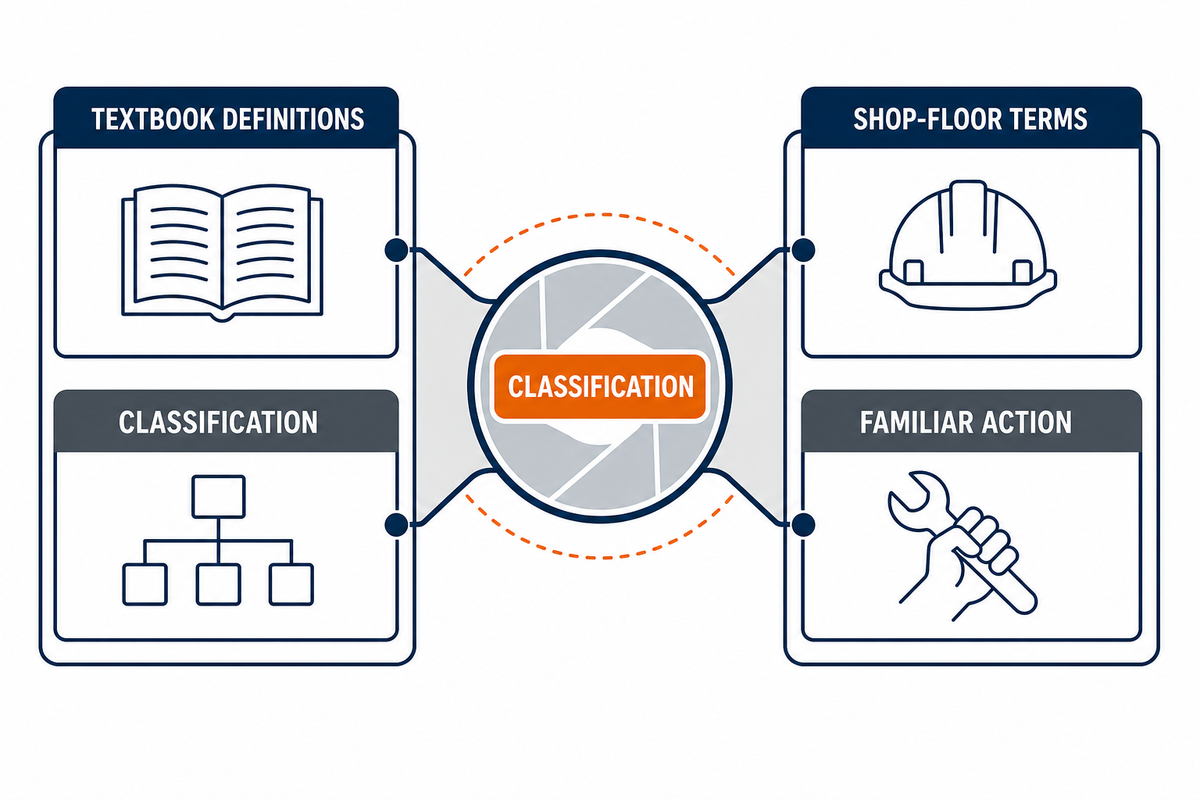
Textbook definitions create distinctions. Shop-floor terms make work communicable. Both have their place because each serves a different communicative purpose when someone needs to distinguish a mechanism from a familiar action or machine label. A textbook may place abrasive, non-traditional, and defined-edge mechanisms in separate groups. A production conversation may begin: “mill a feature”, “turn this diameter”, “wire EDM this profile”. The first statement foregrounds classification; the second foregrounds a familiar action. MIT machining context.
To resolve apparent contradictions between styles, the distinction should be made at the level being discussed. Consider whether the speaker is mentioning an operation, a type of machine, an arrangement, a control, or a mechanism for removal. That question usually solves the issue without the need to create a new definition each time a new phrase is encountered.
How to Read Newer Labels Without Replacing Stable Terms
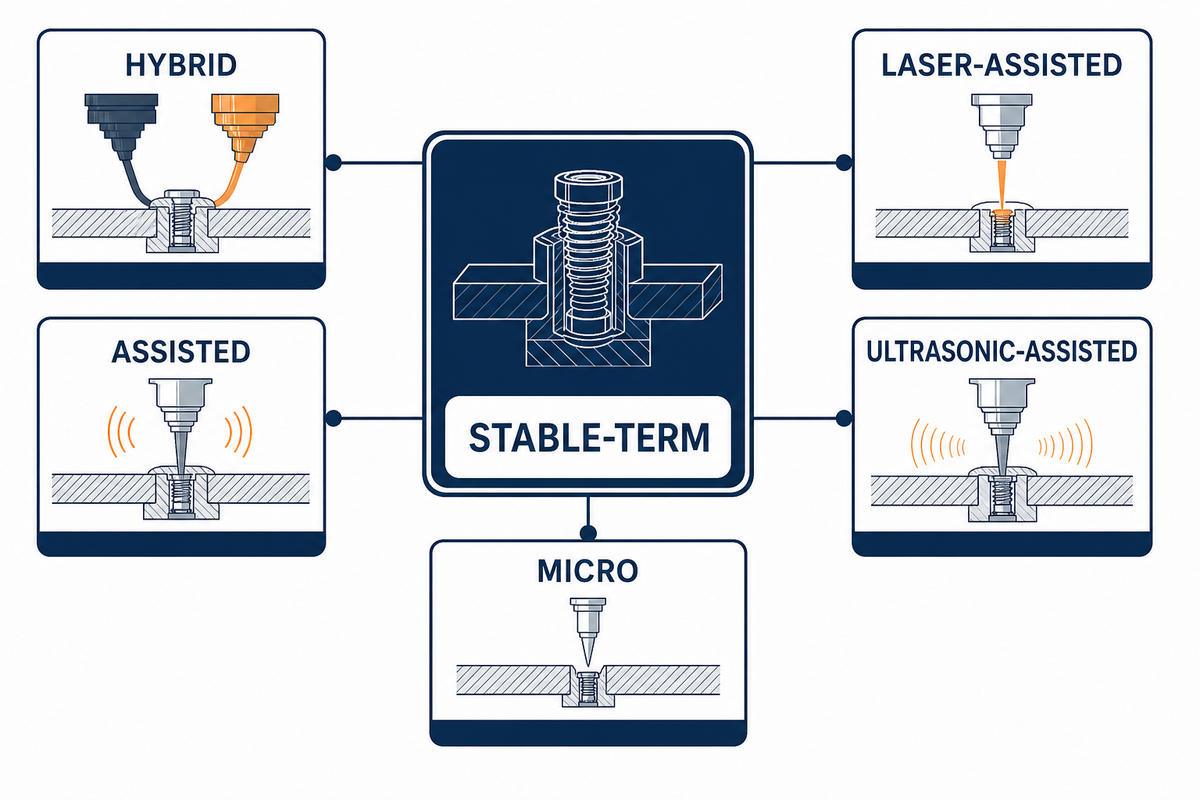
Newer descriptions tend to include words such as assisted, hybrid, laser-assisted, ultrasonic-assisted, or micro. These qualifiers can help to provide more context on an interaction, scale, or configuration. They preserve the stable term that follows while adding a qualifier. In fact, a hybrid name could help to illustrate that multiple interactions are important to a given description. NIST terminology context.
Vocabulary in the various domains of industry, standards, research, and even different workplaces doesn’t align in the use of terms at a constant or uniform pace. Therefore, the safe approach is to consider the addition of a qualifier to a core term. This keeps a new term from being confused for a universal claim of improvement or classification. Lists of types of machining process may place conventional machining or traditional machining beside a non-conventional machining process. Those labels identify broad vocabulary families, not a prescription. A subtractive manufacturing process can be discussed through a turning process or grinding processes; ultrasonic machining, electrochemical machining, and abrasive jet machining name other removal interactions or supporting contexts. Likewise, 5-axis machining identifies a motion-and-control configuration rather than a removal mechanism. A list of different types of machining processes is therefore a useful terminology index, not a route for selecting a process for a particular part.
Types of Machining Process: Conventional and Non-Conventional Terms
A CNC machine can coordinate axis motions while a workpiece or cutting tool may rotate according to the named operation. That wording clarifies control and motion without changing the mechanism identified by the process term.
Within this approach, effective communication can also have room for precision. A term doesn’t need to be exhaustive to be useful, and a new qualifier doesn’t need to completely replace the underlying mechanism to be meaningful. If documentation defines a term, that definition is that term’s meaning for that context and nothing more. Broad guidance such as this can help the reader decipher what kind of information the name might be related to.
How to Use This Guide Without Overreading It
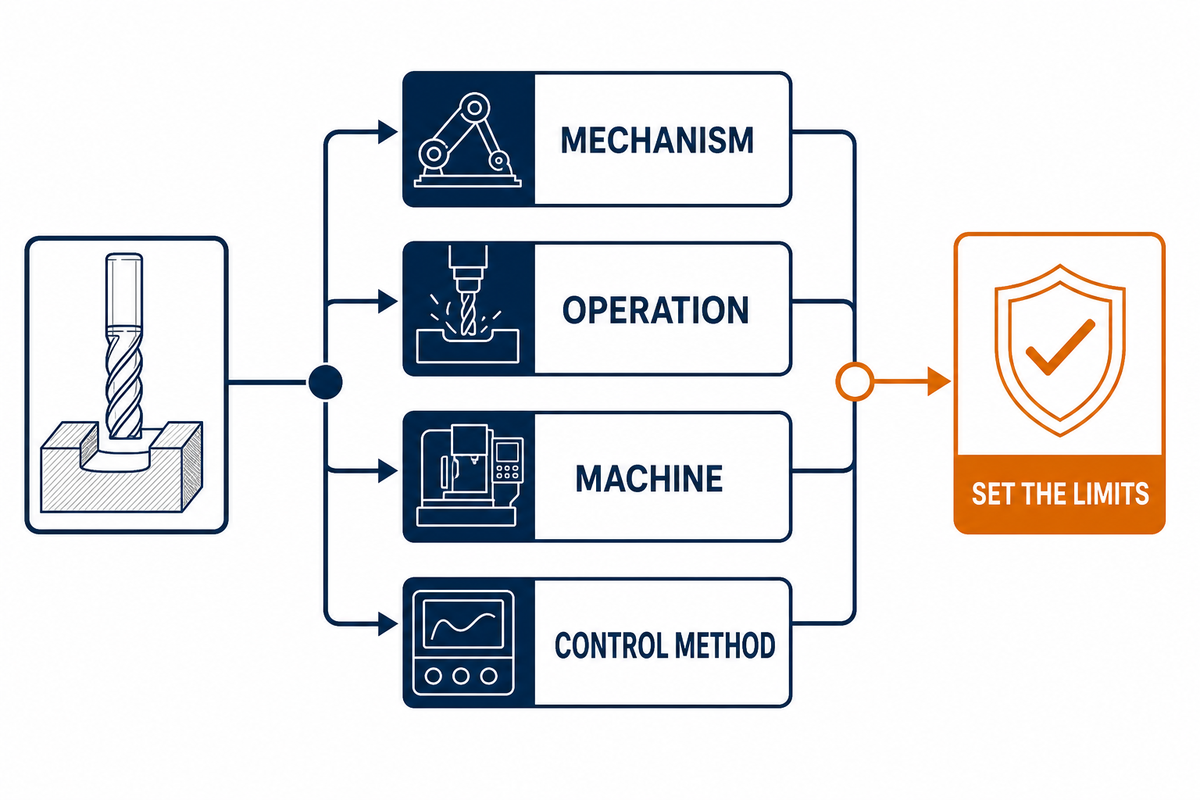
Think of this guidance as a decoder. When you run across a machining term, you need to identify whether it’s a removal mechanism or is an operation, a machine or a control method. Then you need to set the limits of the label. A good definition will help the communication of a technical concept, but it won’t provide the complete context in which the concept is being communicated. NIST terminology reference.
Key takeaway
Read machining names in layers. Mechanism explains the removal interaction, motion explains how tool and workpiece relate, and control explains how the action is commanded. The name remains a starting point, not a complete decision. For publisher background, visit Zhenling Metal.
Frequently Asked Questions
What are machining processes?
Machining processes are methods of removing material to create or alter a workpiece. A broad technical view includes defined-edge cutting, abrasive machining, and energy-based methods. The name can refer to a removal mechanism, a recognizable operation, or a familiar equipment context, so a complete interpretation begins by asking what layer of the work is being named.
Is CNC a machining process?
In this guide, CNC is treated as a control term rather than one material-removal mechanism. Numerical control can coordinate axes and machine functions for milling, turning, drilling, grinding, and other operations. In ordinary speech, “CNC machining” can be a useful umbrella phrase, but it doesn’t specify exactly how material is being removed or what operation is taking place.
Is grinding considered machining?
Yes. Grinding is a material-removal process that uses abrasive grains rather than one geometrically defined cutting edge. The grains act as many small cutting points, and the resulting interaction differs from conventional single-point or multi-edge cutting. That different edge geometry is why grinding merits a distinct description; it doesn’t mean that grinding is outside machining or outside chip-forming material removal.
What makes EDM different from cutting?
EDM removes material through controlled electrical discharges and localized thermal erosion, rather than by a conventional cutting edge shearing material. Conventional EDM normally requires a conductive path through the workpiece. Assisted approaches for certain nonconductive ceramics exist, but they’re qualified variants and shouldn’t be used to describe conventional EDM as a universal method for every material.
The distinction is about the removal mechanism; it is not a basis for inferring a particular setup, result, or application route from the name alone. A technically complete description still needs the specific EDM configuration and its documented operating context, not just the three-letter abbreviation.
What is the difference between a process and an operation?
A process usually names a material-removal method or family, while an operation names a recognizable act performed within manufacturing. The boundary isn’t always rigid in everyday speech. The useful habit is to ask whether the term is describing the removal interaction itself, a specific action, the machine that performs it, or the control system coordinating it.
Do hybrid machining labels replace conventional names?
Usually, a hybrid or assisted label adds context rather than replacing the stable core term. It may indicate that a second interaction, energy source, or configuration is relevant. Because terminology isn’t adopted uniformly across every technical setting, read the qualifier as additional information and avoid treating it as a universal claim about outcomes or classification.
Conclusion
Machining vocabulary can be confusing. However, when understood through a series of layers, it can be simpler. Different removal mechanisms include defined-edge cutting, abrasive contact, and energy-based interactions. Different processes like turning, milling, drilling, grinding, and EDM can all illustrate different parts of this. CNC describes control and doesn’t necessarily refer to a specific mechanism. When distinctions between these mechanisms are recognized, terminology is easier to use and readers can avoid overselling what a process name can convey.
For application-specific process context, see the application-facing process reference.
References & Sources
- Precision in Machining: Research Challenges National Institute of Standards and Technology.
- Machining Massachusetts Institute of Technology, 2.810 lecture material.
- Electro Discharge Machining University of Cincinnati Micro and Nano Manufacturing Laboratory.
- Electrical Discharge Machining: An Overview of Current Research and Applications peer-reviewed review article.
- Electrical Discharge Machining of Nonconductive Ceramic Materials peer-reviewed review article.
Editorial note: The 3-Layer Mechanism-Motion-Control Triad is a transparent reading aid created for this guide. It isn’t a manufacturing standard, a process-selection method, or a claim about a specific part or result.