

Updated October 2026 · By Zhenling Metal
Fiberglass takes the form of glass drawn into very thin fibers. When used to describe manufactured parts, it generally means the fibers are combined with a polymer resin to form a glass-reinforced composite. Glass provides reinforcement; the resin binds fibers, transfers load and provides shape. Thus a roll of cloth, an insulation batt and a machined G10 plate denote very different products.
Quick Specs: What to Specify
- Material family: glass fiber alone, or glass fiber plus a named resin.
- Reinforcement: glass chemistry, fabric construction and fiber directions.
- Finished material: grade, thickness, cure and test conditions.
- Part acceptance: dimensions, edge quality, electrical or mechanical requirements.
Key Takeaways
- Wet glass doesn’t necessarily mean a compatible mat binder or a qualified laminate.
- E-glass is a glass chemistry; cloth and mat are reinforcement forms. Choose both.
- Compare finished laminates in the same direction and test condition, rather than comparing bare-fiber strength with metal strength.
- For machining, abrasive fibers and unsupported edges change tool selection and workholding.
What Is Fiberglass? Glass Fibers and Composite Materials
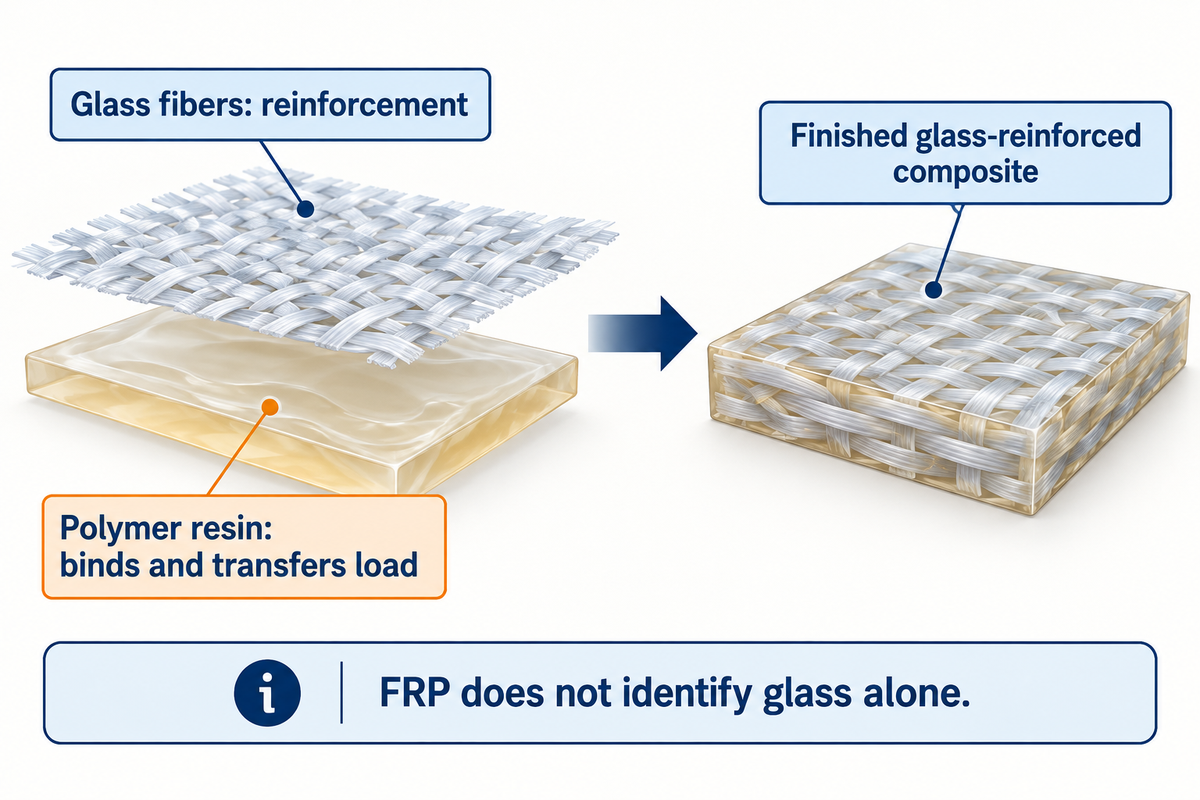
A glass composite may be considered reinforced fabric held in a solid binder. Fiberglass supplies the fibers and a resin matrix binds and transfers load between them. The finished composite material may be a flexible molded shell or a rigid laminate, and performance is a function of the raw materials and the means of its manufacture.
The Washington State Department of Health’s fiberglass overview details some of the glass fibers. Structural parts add a separate material, the polymer, and international data sheets may refer to the reinforcement as glass fibres. Glass-reinforced plastic (GRP) is a branch of fiber-reinforced plastic (FRP), and FRP includes carbon and other reinforcement materials; therefore, FRP alone doesn’t define glass.
What else is fiberglass called?
Fiberglass is often written as fibreglass, particularly in British English, where fiber is written fibre. For resin-bound parts, the terms Glass Reinforced Plastic (GRP) or Glass Fiber Reinforced Plastic (GFRP) are more precise. Glass wool describes an insulation product; for a reinforcement fabric, the term glass cloth is appropriate. These names should be kept separate on a drawing or purchase order.
When comparing types of fibreglass, the material family and product form should be considered separately. A request for “fiberglass sheet” still leaves the resin, reinforcement and grade open. In a material callout, “woven glass/epoxy laminate” defines the structure; a grade and thickness define it further. The 2021 review of carbon- and glass-fiber composites discusses reinforcement, matrix materials and their interactions across several manufacturing routes.
Types of Fiberglass: Glass Chemistry and Reinforcement Forms
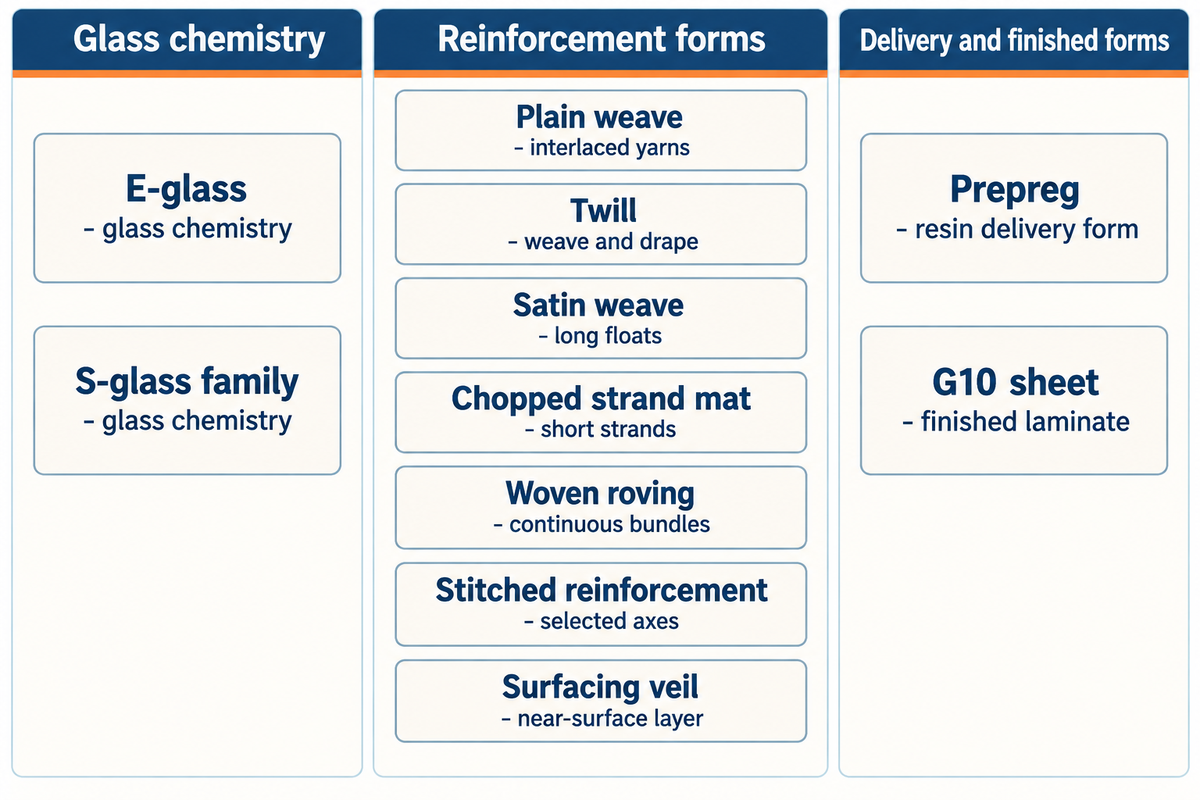
Choose fiberglass on two levels: Reinforcement form and composition. E-glass and S-glass define a family of glasses. Plain weave fabric, twill, chopped strand mat and roving define the supply and arrangement of fibers. A fabric description becomes useful only when both these levels correlate with the required resin and part geometry.
Cloth-or-Mat Selector
The Cloth-or-Mat Selector is used to evaluate fiber continuity, direction, drape and binder compatibility before choosing a reinforcement form.
| Choice | Classification level | What it controls | Selection question |
|---|---|---|---|
| E-glass | Glass chemistry | General-purpose reinforcing glass | Does the finished grade meet the required properties? |
| S-glass family | Glass chemistry | Higher-performance glass formulations | Does the specified grade justify the material change? |
| Plain weave | Fabric construction | Interlaced warp and fill yarns | Is a stable cloth suitable for the shape? |
| Twill | Fabric construction | Weave style and drape | Will the fabric conform without distorting yarns? |
| Satin weave | Fabric construction | Longer yarn floats and handling characteristics | Can placement preserve the intended directions? |
| Chopped strand mat | Reinforcement form | Short, randomly oriented strands | Is the binder compatible with the selected resin? |
| Woven roving | Reinforcement form | Woven continuous strand bundles | Does the construction suit the laminate schedule? |
| Stitched reinforcement | Reinforcement form | Held fiber layers with selected directions | Which axes need reinforcement? |
| Surfacing veil | Surface reinforcement | Fine reinforcement near the surface coat | What finish and barrier construction are needed? |
| Prepreg | Resin delivery form | Reinforcement supplied with controlled resin | Are its storage and cure requirements practical? |
| G10 sheet | Finished laminate | Consolidated woven glass and epoxy | Which sheet specification applies? |
What are the key differences between fiberglass mat and fiberglass cloth?
Fiberglass cloth maintains constant, continuous fibers in a defined pattern. A conventionally prepared chopped strand mat is made up of a binder that holds together short strands. Cloth makes specifying reinforcement directions easier. While mat can conform and build thickness, resin compatibility matters. Random strand orientation doesn’t make every cured mat laminate equally strong in all directions.
In an orthogonal woven cloth, warp and fill yarns run at 0 and 90 degrees. Relative to the part, the directions can be altered by rotating the fabric. A heavier fiberglass fabric also alters the amount of resin required for wet-out; the weight of the fabric alone doesn’t state the cured thickness. For strand matting, indicate the weight unit as well: Tom Pawlak’s EpoxyWorks suggests that mat and cloth are usually described in terms of per square foot and per square yard, respectively.
There’s more glass chemistry to consider. AGY’s S-2 Glass documentation describes multiple yarn, chopped-fiber and roving formats with application-specific sizing. A high-strength glass label doesn’t decide the weave, resin, or the acceptance test of the finished part. An appropriate procurement substitution should retain those decisions, rather than replace E-glass with other chemistries based on name alone. The composite-manufacturing review classifies glass fiber types and describes the manufacturing routes for their composites.
How Resin and Manufacturing Set the Finished Material
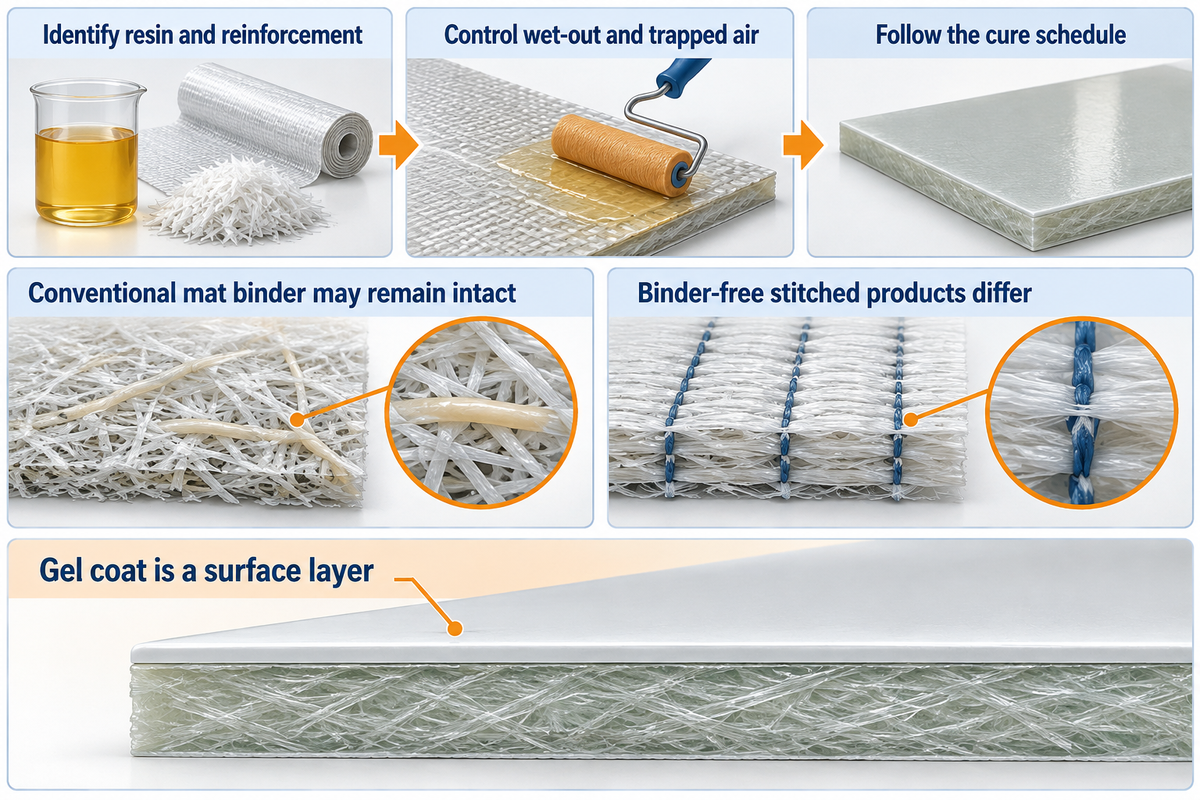
Resin and processing turn dry reinforcement into a usable part. Common thermoset matrices include polyester resin, vinyl ester resin and epoxy resin. However, their working and cured properties are different. The laminate schedule, fiber wet-out, consolidation and cure determine how much of the reinforcement’s potential is captured in the finished part.
A laminating resin must wet the fibers and be suited to the manufacturing route. Mixed viscosity controls the flow, while hardener and hardener speeds control the working time and cure. Follow the resin maker’s mixing and post-curing instructions; adding extra hardener is not a general shortcut. A gel coat provides a surface layer, rather than replacing the structural reinforcement behind it.
“the binder holding things together does not dissolve”
Pawlak states that epoxy can saturate the glass in a conventional mat while leaving its styrene-soluble binder intact. That mat is stiffer and can be more difficult to adjust to curves than is the case with polyester. Binder-free stitched products are a different case. The binder joining chopped strands is also different from the sizing on individual fibers, which affects the interface between the fibers and resin.
1. Identify
Record resin, reinforcement and binder compatibility.
2. Consolidate
Control placement, fabric wet-out and trapped air.
3. Cure
Follow the specified time and temperature schedule.
Hand layup places and wets reinforcement in a mold; infusion draws resin through a dry stack; pultrusion produces continuous profiles. The manufacturing review discusses these procedures in detail, along with other techniques. For a curved cover in a hypothetical design, a drapable lay-up may suit the shape better than machining it from a flat plate. Rejecting a stiffer mat on that geometry doesn’t mean rejecting all mat-and-epoxy combinations.
Fiberglass Properties: Read the Laminate Data
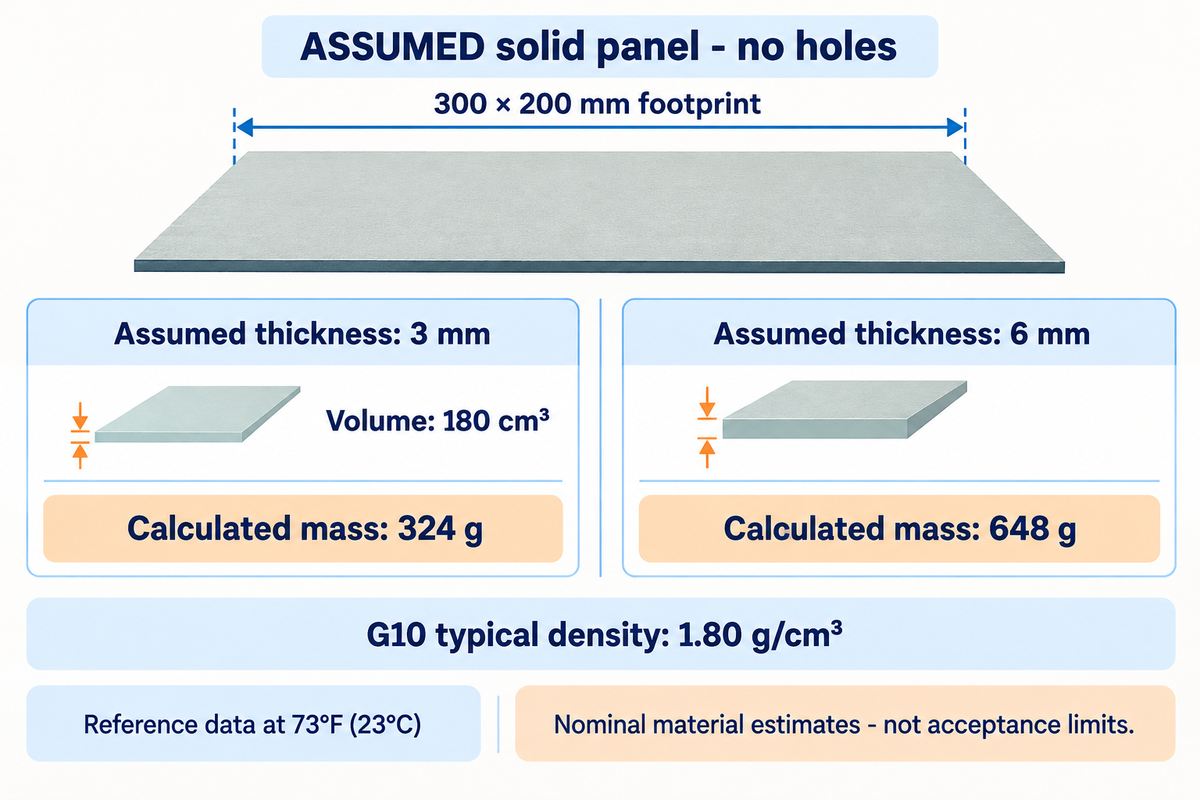
A typical density of 1.80 g/cm³ appears in Laminated Plastics’ G10 data sheet for a finished woven-glass/epoxy laminate. Fiberglass properties are characteristic of a defined material and test condition. Analyze the grade, loading direction, thickness, and conditioning, along with each strength, moisture, or electrical value.
Fiber, Matrix, Part
Fiber, Matrix, Part separates reinforcement properties, resin behavior and the finished-component requirements so that a value is always connected to the material actually tested.
Strength properties describe the tested material. Glass-fiber tensile strength is not the same as a sheet’s flexural strength. The active D709-25 specification of ASTM addresses laminated insulating materials, including glass-fabric layers bonded by thermosetting resin. For a component drawing, match that material with the grade’s strength and electrical requirements. ASTM’s historical D790-17 method page also explains how ply sequence affects the flexural behavior of orthotropic laminates.
| Property | Test method | Typical value |
|---|---|---|
| Density | ASTM D792 | 1.80 g/cm³ |
| Water absorption, 24 hours | ASTM D570 | 0.10% |
| Tensile strength, LW | ASTM D638 | 45,000 psi |
| Tensile strength, CW | ASTM D638 | 38,000 psi |
| Flexural strength, LW | ASTM D790 | 75,000 psi |
| Flexural strength, CW | ASTM D790 | 65,000 psi |
| Flexural modulus, LW | ASTM D790 | 2,700 Kpsi |
| Flexural modulus, CW | ASTM D790 | 2,400 Kpsi |
| Compressive strength | ASTM D695 | 65,000 psi |
Atlas Fibre, in a separate source, provides the same approximate typical specific gravity of 1.8 for G10, as well. For strength, compare each supplier’s own tensile and flexural values in the same direction and test condition rather than relying on matching density. In particular, electrical insulation and dimensional stability require evaluation under the actual temperature, moisture and geometry requirements.
Worked Example: Flat G10 Sheet Mass
Assume a solid rectangular panel measuring 300 × 200 × 3 mm, without holes, and use the cited typical density of 1.80 g/cm³. Its volume is 30 × 20 × 0.3 = 180 cm³. Mass = density × volume = 1.80 × 180 = 324 g. At an assumed thickness of 6 mm with the same footprint and density, the calculated mass is 648 g. Both results are nominal material estimates; machined features and thickness variation change the delivered part’s mass.
If an electrical spacer is required to fill a fixed assembly gap, choose the thickness and machining allowance; then estimate mass for shipping or handling. A material that meets dry strength requirements may not meet the requirements for wet electrical service. State the service conditions with the dimensioned drawing requirements, and compare engineering material options.
Fiberglass vs Carbon Fiber, Metals and Other Plastics
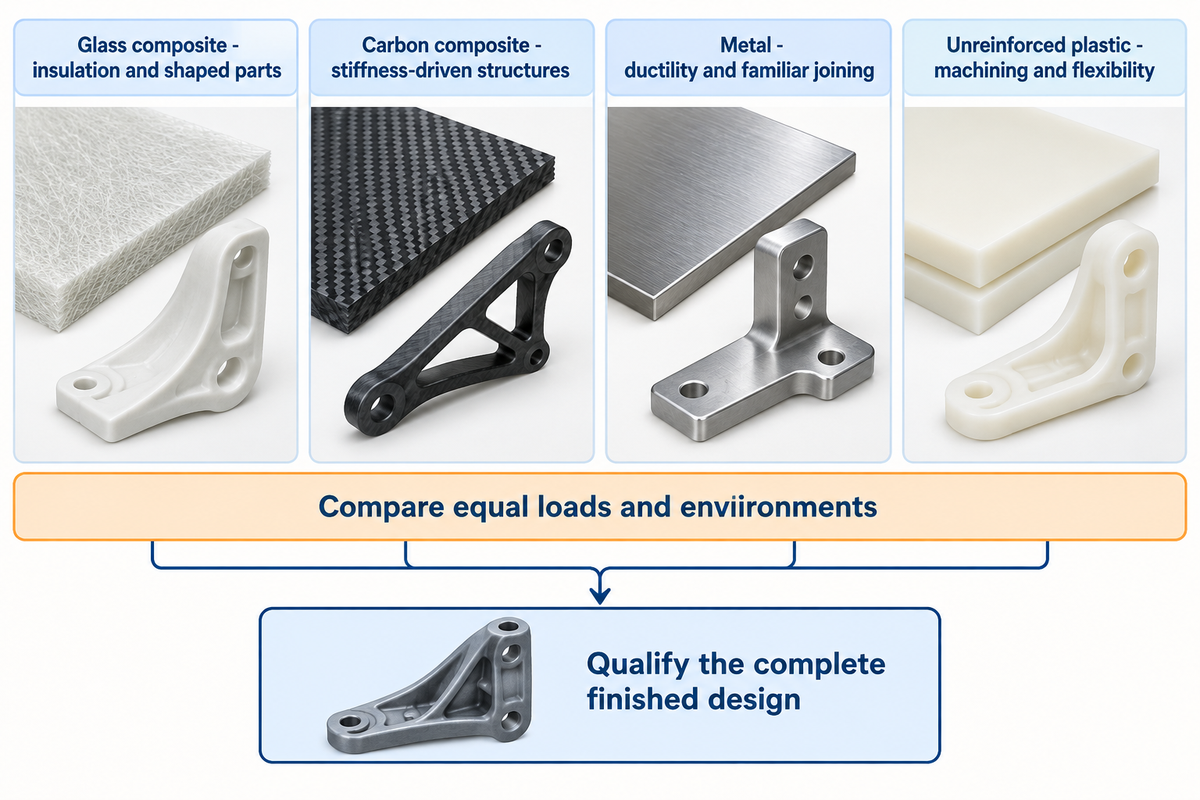
Glass composites can combine reinforcement materials and resin for low conductivity in electrically insulating parts. Stiffness-driven composite structures can use carbon composites, but for ductility and familiar joining options, metal can be considered. Analyze completed designs under equal loads, environments and acceptance criteria before assessing one as stronger, lighter and cheaper.
Glass Composite
Consider for insulation, corrosion resistance and shaped composite parts. Confirm laminate direction, resin and edge quality.
Alternative Material
Consider carbon for stiffness, metal for ductile behavior, or unreinforced plastic when machining and flexibility matter more than reinforcement.
The glass- and carbon-composite review describes their difference in reinforcement and fabrication. At the part level, wall thickness and the direction of the load may affect the outcome. It’s incorrect to compare the tensile strength of fiber to the yield strength of steel to support the use of a different material.
Corrosion resistance depends on all components of the complete system. Resin, exposed cut edges, adhesives, fasteners and the service fluid are also important. For wet service conditions, use strength data after the relevant moisture and temperature conditioning. For assemblies that require adhesive bonding, the joint specification should include adhesive properties and surface preparation instead of basing it on the sheet data alone.
A fair mass comparison should reflect the same design requirement. Equal-thickness sheets should be compared for stock-material selection, and equally stiff brackets for structural adequacy. Purchasing teams should separate these types of comparisons when assessing a proposed material replacement.
Common Industrial Applications and Material Tradeoffs
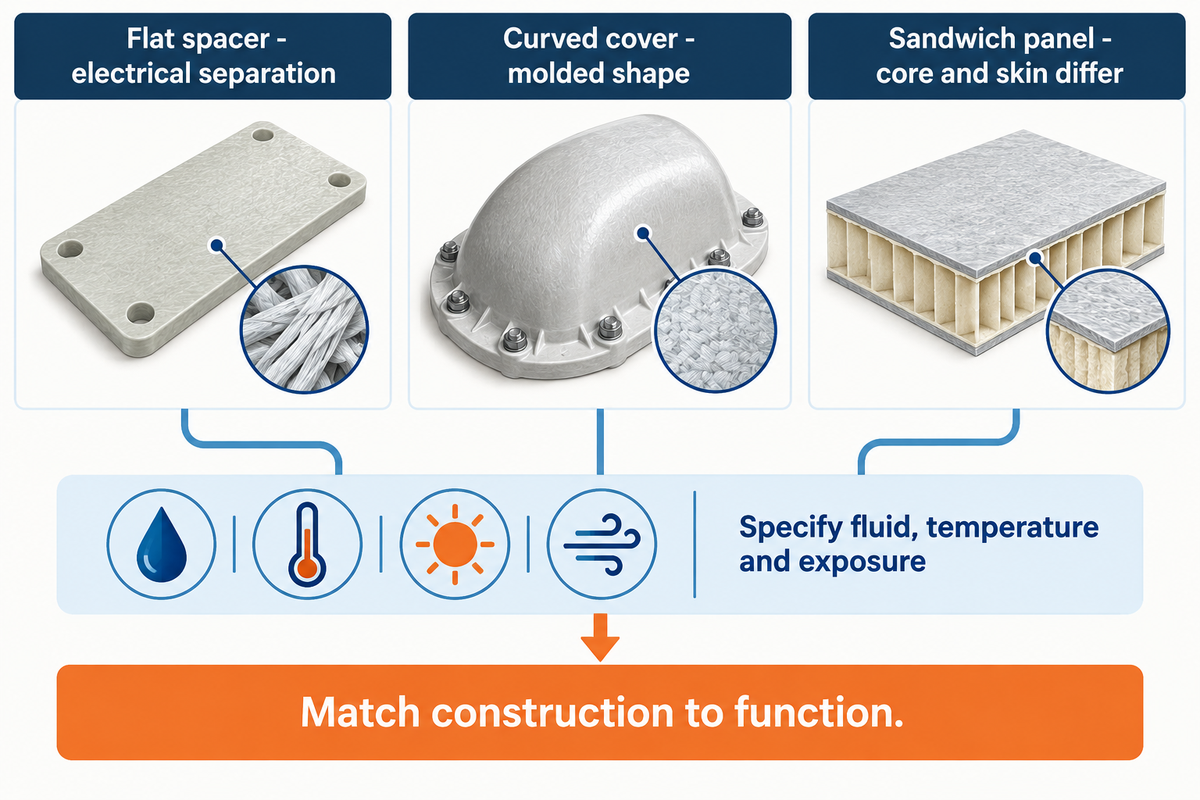
In electrical laminates, molded covers, and corrosion-resistant structures and profiles, glass composites can provide insulation for a spacer, formability for a cover, or resin-controlled durability in a wet environment. Don’t borrow a grade from a different industry before matching the material construction to the function.
Glass reinforcement is used in construction, transport, marine equipment and aerospace. The manufacturing review links these applications to several fabrication routes. Prepreg can provide controlled resin delivery; a polyurethane foam core in a sandwich panel serves a different function from the reinforcing skin. Neither term by itself specifies the finished panel’s load capacity.
Let’s take the example of a curved face, wet service cover with a bolted rim. A molded glass laminate accommodates the curve, while the rim requires adequate support for loading of the fasteners. The design team would name the fluid, temperature and exposure cycle, and select the resin and sealing detail. A dry electrical G10 sheet specification would address a different problem. For the buyer, “corrosion resistant” is a beginning property: the purchase description should specify the service medium and the surfaces exposed after trimming, drilling and assembly.
Machining Fiberglass: Tool Wear, Edges and Workholding
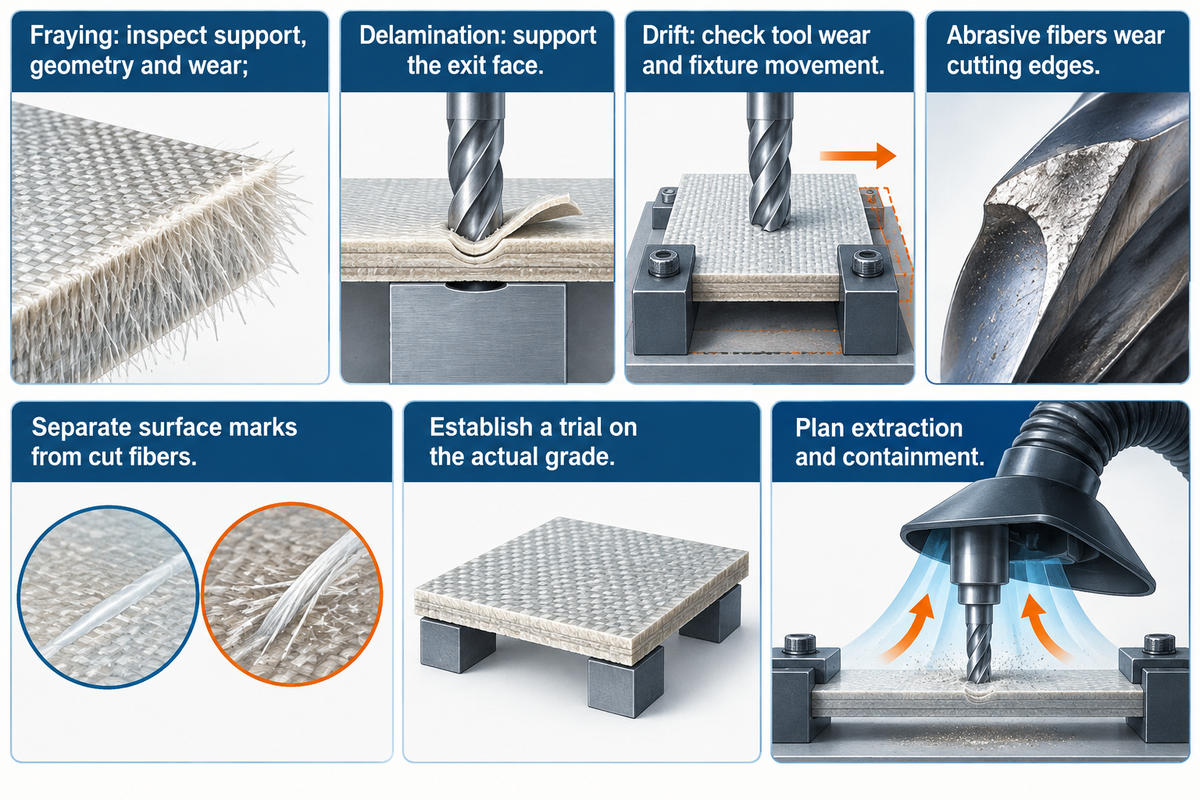
Machining cured fiberglass requires abrasion-resistant cutting edges, firm laminate support and control of airborne debris. Glass wears tools, and unsupported plies can lift, fray or delaminate at an edge. Establish a trial cut on the actual grade and thickness, with acceptance criteria for dimensions and visible edge damage.
What are the downsides of fiberglass?
Fiberglass can suffer impact damage, direction-dependent strength, moisture-related changes and difficult end-of-life handling. During machining, abrasive reinforcement wears cutting edges and can leave chipped or separated plies. The importance of each drawback depends on the resin, reinforcement architecture and service conditions; a rigid electrical laminate and a molded cover face different limits.
A 2022 experimental GFRP trimming study tested specific polycrystalline diamond and cemented carbide tool geometries, both fresh and worn. An inclined-edge diamond tool performed well for both force and delamination in that test. The result supports checking geometry and edge condition; it doesn’t give a universal cutting recipe for each fiberglass sheet.
- Frayed exit edge: inspect backing support, tool geometry and wear before changing several cutting parameters together.
- Delamination near holes: support the exit face and review how the drill enters and leaves the laminate.
- Dimensional drift: check tool wear and fixture movement as well as the machine setting.
- Damaged surface: distinguish removable surface marks from cut reinforcing fibers.
Before sanding a cosmetic resin layer to remove imperfections, set a surface allowance. Careful surface sanding of finished parts can remove superficial marks in that layer. Sanding finished parts without cutting structural fibers needs adequate resin above the reinforcement; cutting into the reinforcing fabric changes the laminate itself. A mold-side finish places the surface coat against the mold, with reinforcement directly behind the surface coat and heavier cloths added as required by the laminate schedule. Sanding can’t repair a structurally separated ply. Repair materials also require a separate specification for compatibility and repair processes.
The NIOSH fibrous-glass overview mentions product labels and the hierarchy of controls in relation to safety data sheets. Plan extraction, containment and cleanup for the resin/glass system before cutting. For planning the setup, review workholding principles and differences in machining processes.
What Changes the Cost of a Fiberglass Part?
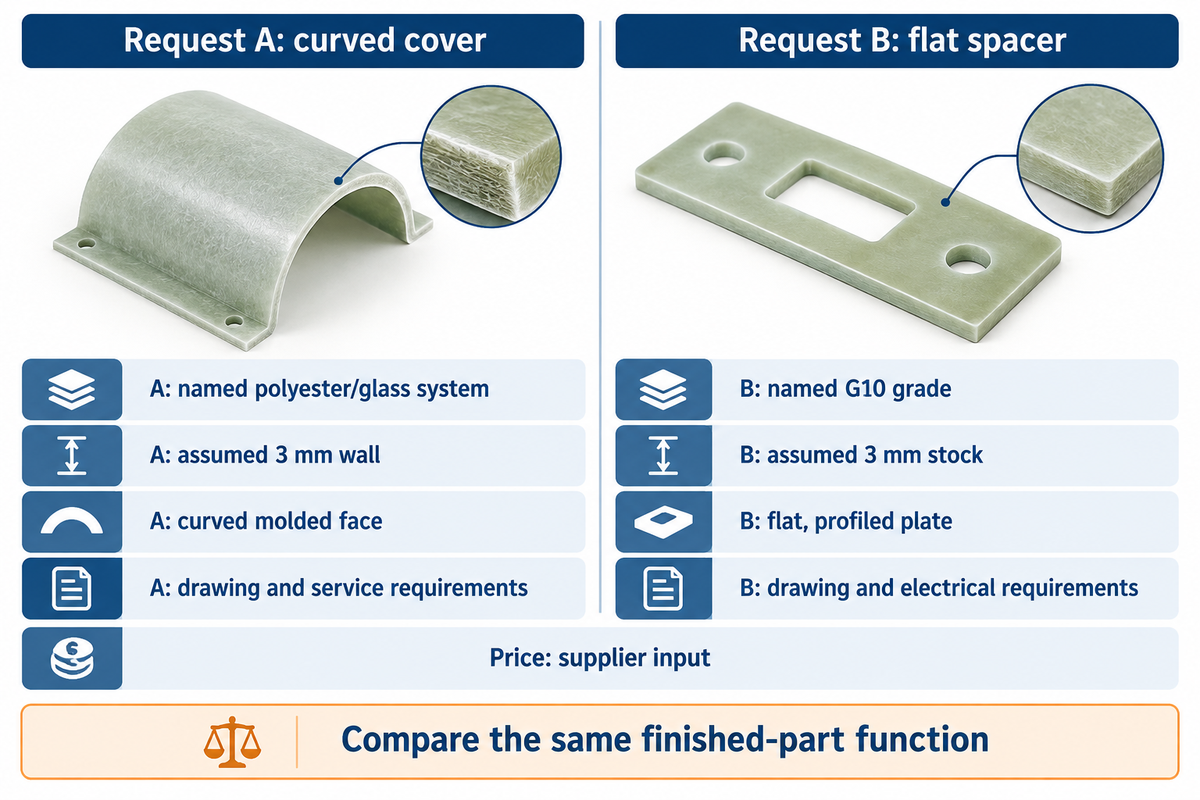
The prices of fiberglass parts reflect the resin, reinforcement, thickness, manufacturing route, machining and inspection. A polyester molded panel and a machined G10 component represent different systems and work content. Normalize those items before comparing quotations, then compare accepted part costs rather than raw material prices: one online listing prices a 12 x 12 in, 1/8 in thick G-10/FR-4 plate at $29.99 for 1 to 4 pieces, before any cutting, machining or inspection.
The manufacturing review justifies hand lay-up, infusion and continuous processes for various shapes and needs. Fabric construction, ounce-weight of the fabric and the amount of resin in the lamination affect material use.
| Quotation field | Request A: curved cover | Request B: flat spacer | Buyer decision |
|---|---|---|---|
| Function | Protective enclosure | Electrical separation | Compare offers for the same function |
| Material callout | Named polyester/glass system | Named G10 grade | Approve the complete material designation |
| Reinforcement | Specified cloth/mat schedule | Woven glass laminate | Preserve construction and direction |
| Nominal thickness | Assumed 3 mm wall | Assumed 3 mm stock | State tolerances separately |
| Shape | Curved molded face | Flat, profiled plate | Include tooling or stock removal |
| Surface | Specified mold-side finish | Specified machined edges | Define accepted appearance |
| Secondary work | Trim and drill | Profile and drill | Include all finished features |
| Verification | Drawing and service requirements | Drawing and electrical requirements | Price the same inspection scope |
| Quantity | Buyer-defined accepted quantity | Buyer-defined accepted quantity | Use the same delivery and yield basis |
| Price | Supplier input | Supplier input | Separate tooling, parts and inspection |
For a repeat order, record whether material waste, setup and inspection are included in the unit price; otherwise a cost comparison may count them twice. Begin with the site’s material requirement builder, then use the material inquiry completeness check to assemble the drawing, grade and acceptance details.
What Is Changing in Glass Composites?
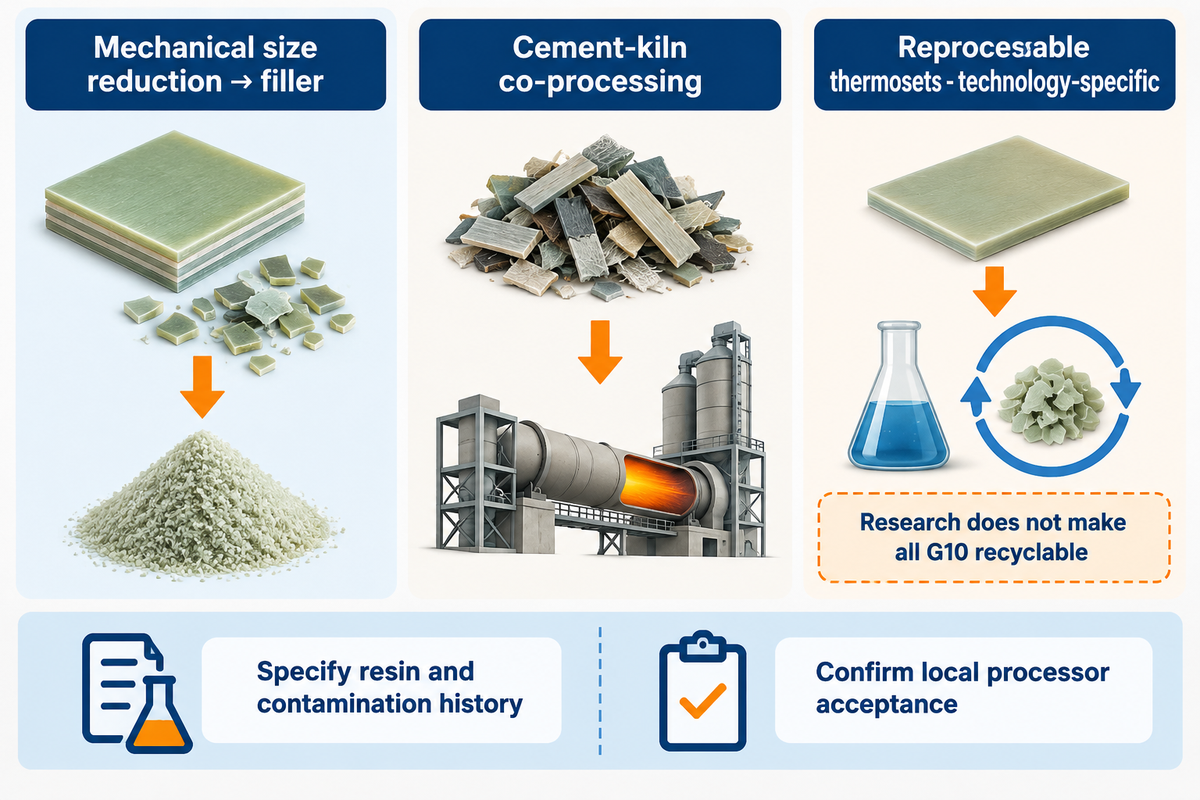
End-of-life recovery is increasing the importance of resin selection and waste management in glass-composite development. Research now includes reprocessable thermoset systems and methods to capture value from existing laminates. For a buyer, the major shift is to understand the material chemistry and identify a viable recovery route before evaluating recyclability as a purchasing benefit.
A 2025 R&D 100 award description mentions the recyclability of polyester thermosets and reinforced composites based on an epoxy-anhydride system, and credits Oak Ridge National Laboratory. The description includes glass among the reinforcement options. It concerns a developer’s technology, rather than a broad recycling property of traditional G10 or polyester/glass parts.
Earlier, CompositesWorld’s 2023 EMPHASIZING report reported on a project aimed at upcycling glass fiber. The proposed improvements were the project goals. When working with composites made from recovered reinforcement, a promising route needs a qualified material, usable feedstock and a functioning supply chain.
Composites UK’s end-of-life guidance describes various routes for material recovery, including mechanical size reduction, cement-kiln co-processing and others, with commercial and supply-chain constraints. Grinding a laminate into a filler isn’t the same as recovering continuous reinforcement for the same structural function. Describe how production offcuts will be segregated and where the local processor accepts them. Include the resin identity and contamination history with that waste stream.
Zhenling Metal’s resources can assist in organizing a part brief based on the drawing, service environment and verification needs. Synthesize these requirements before requesting a material substitution or a machining quotation.
Frequently Asked Questions
Many fiberglass questions can be answered by distinguishing between dry glass fiber, a cured laminate or a finished part. Replies to these questions discuss various aspects of plastic content, moisture, electrical behavior, weight, and strength. Choice of material still starts with the grade and the conditions in which it will be used.
Is fiberglass plastic?
A fiberglass composite usually contains plastic resin reinforced with glass fibers. The glass itself is inorganic, while the polymer matrix can be a thermoset or thermoplastic. In a finished sheet or molded part, “fiberglass” commonly names the combination. Dry glass cloth and glass wool don’t automatically contain the same structural resin system.
Is fiberglass waterproof?
Cured glass composites can resist water, but they can also absorb moisture. Water resistance comes from the resin system, laminate quality and surface construction, including joints and cut edges. Select a grade for its actual immersion or humidity exposure. A low water-absorption result under one laboratory method is different from permanent waterproof performance.
Does fiberglass conduct electricity?
Glass and many glass-reinforced resin laminates serve as electrical insulators. Finished-part insulation depends on the resin, additives, thickness, moisture and test conditions, however. Conductive fillers or attached hardware can change an assembly’s behavior. Choose an electrical grade and specify the required test instead of treating the word fiberglass as an insulation rating.
Which is lighter, fiberglass or aluminum?
Usually fiberglass: many glass/polymer laminates are less dense than aluminum, which the Royal Society of Chemistry lists at 2.70 g/cm³ for the pure metal (the woven-glass/epoxy laminate above is about two-thirds of that), but part weight also depends on thickness and geometry. Compare finished designs that satisfy the same duty. A thicker composite component may lose the weight advantage suggested by a simple equal-volume comparison.
Is fiberglass stronger than steel?
No single strength ranking covers fiberglass and steel. A glass composite can provide useful strength at low mass, yet its properties vary with fiber direction, resin, reinforcement fraction and manufacture. Steel has different stiffness, ductility and failure behavior. Compare the finished laminate’s relevant test result with the selected steel grade under the same design requirement. For a bracket, that may mean bending stiffness and joint performance rather than tensile strength alone.
Can fiberglass be recycled?
Some glass composites can enter mechanical recycling or other recovery routes. Availability depends on the resin, contamination and local processing network. Recovered material may become filler or enter cement production rather than return to the original continuous-fiber structural application.
Which fiberglass cloth is strongest?
Cloth aligned with the main load is the best starting choice for a strength-driven laminate. Glass chemistry, yarn construction, fabric weight, weave, resin and consolidation all affect the result. A cloth aligned with the main load can be more useful than a nominally higher-performance fabric placed in the wrong direction. Specify the required strength test and laminate schedule together. For multidirectional loading, review the complete stack rather than selecting only the heaviest cloth or the most expensive glass type.
References & Sources
- Fiberglass Washington State Department of Health.
- Manufacturing Technologies of Carbon/Glass Fiber-Reinforced Polymer Composites and Their Properties: A Review Academic review, published 2021; National Library of Medicine full-text archive.
- D709-25: Standard Specification for Laminated Thermosetting Materials ASTM International, active edition; public scope and metadata.
- D790-17: Standard Test Methods for Flexural Properties ASTM International, historical edition; public significance and use.
- Experimental comparison of cutting-tool geometries for GFRP trimming Ducobu and colleagues, 2022; National Library of Medicine abstract record.
- About Fibrous Glass National Institute for Occupational Safety and Health, 2026.
- Recyclable Polyester Thermosets and Reinforced Composites R&D World, 2025 R&D 100 award description; developer: Oak Ridge National Laboratory.
- EMPHASIZING project investigates glass fiber upcycling CompositesWorld, 2023 project report.
- End-of-Life Options Composites UK.