

ABS plastic is a tough, machinable thermoplastic used for housings, prototypes and molded components. Its strength is in the combination of impact resistance and stiffness, and a surface that’s ready for further fabrication. Selecting it starts with the grade and the working environment: heat, sunlight and assembly chemicals can affect how an ABS part functions.
For a machined enclosure, you should first source solid stock from a reputable supplier. Then compare that supplier’s data with load and temperature at the mating features. A printed sample, a forming sheet, and a machined block can share the ABS name. However, they behave differently.
ABS material: what this thermoplastic is
ABS stands for acrylonitrile butadiene styrene. This versatile thermoplastic is an amorphous thermoplastic polymer. It’s composed of the three constituents listed above. Manufacturers adjust the formulation by fine-tuning the balance of constituents. The resultant material is a thermoplastic. ABS can be softened by further heating unlike thermosets. The ability of ABS to be softened by heating supports a number of manufacturing processes e.g. extrusion and molding.
The rubber structure allows ABS to absorb impact. Styrene gives it stiffness and surface quality. Acrylonitrile gives it chemical resistance. The formulation determines how a grade is characterized on a datasheet and connects ABS properties and applications. Ensinger’s overview of ABS describes this balance and its availability as machinable stock.
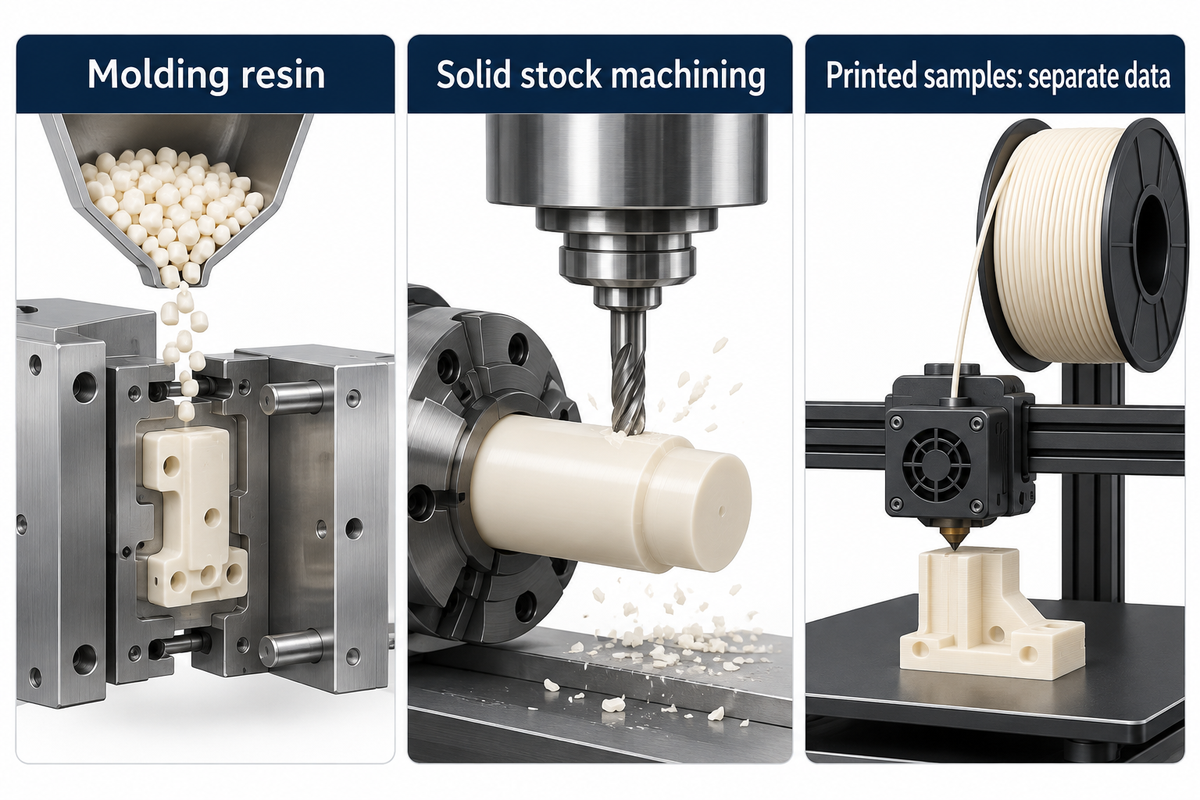
Injection molding creates shapes using resin. Extrusion creates shapes like plastic sheets and rods. CNC machining can create shapes from solid stock. However, the behavior of the final part will still be limited by the behavior of the stock from which it was made.
Keep 3D printing results separate. In Golubović and colleagues’ (2023) comparison of ABS filament and ABS-like resins, different mechanical behavior is demonstrated among the printing processes studied. These findings are on printed samples and don’t include any property values for a machined ABS plate.
ABS plastic properties: strength, density and stiffness
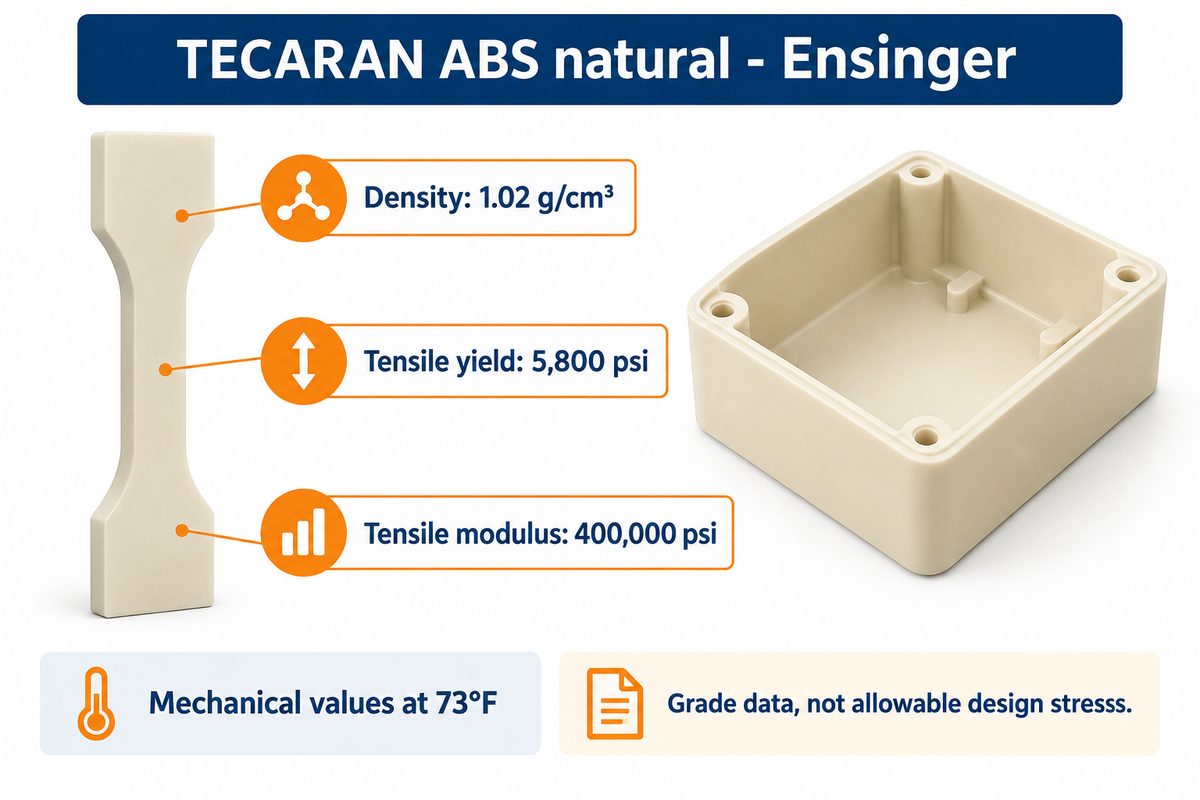
Ensinger lists a density of 1.02 g/cm³ for TECARAN ABS natural. Lightweight housings benefit from low density, while tensile and flexural material properties help compare loading behavior. Use the table as an illustration of one supplier’s grade, with specified test conditions, and not as specs for all ABS material.
| Property | Published value | Condition or method | Selection use |
|---|---|---|---|
| Density | 1.02 g/cm³ | Supplier Facts section | Estimate stock or part mass from volume |
| Tensile strength at yield | 5,800 psi, about 40 MPa | 73°F; ASTM D638 | Compare the onset of permanent tensile deformation |
| Tensile strength at break | 4,000 psi, about 28 MPa | 73°F; ASTM D638 | Keep break and yield values separate |
| Tensile modulus | 400,000 psi, about 2.76 GPa | 73°F; ASTM D638 | Compare initial tensile stiffness |
| Elongation at yield | 2% | 73°F; ASTM D638 | Identify the reported yield condition |
| Elongation at break | 30% | 73°F; ASTM D638 | Understand stretching before specimen failure |
| Flexural strength | 8,900 psi, about 61 MPa | 73°F; ASTM D790 | Compare behavior under bending |
| Flexural modulus | 310,000 psi, about 2.14 GPa | 73°F; ASTM D790 | Screen stiffness for covers and panels |
| Notched Izod impact strength | 5.3 ft·lbf/in | 73°F; ASTM D256 | Compare only compatible specimen and test conditions |
Source: Ensinger TECARAN ABS Natural Technical details . Metric pressure conversions are rounded. Published values describe test specimens, and don’t reflect allowable design stresses or Zhenling test results.
When comparing engineering plastics, toughness, stiffness and bending behavior answer different questions. A cover with excellent impact resistance can still bend enough to disturb a connector opening. Wall span, ribs and fastening position affect that bending. Balance rigidity and flexibility at the feature level, since a lid panel and its snap-fit need differing behavior with regard to deformation. Increasing impact strength, on its own, doesn’t resolve deflection of an unsupported panel.
Is ABS a high quality plastic?
Yes, ABS can certainly be a good quality engineering material for rigid housings and functional prototypes, as long as the grade is correct for the application. ABS plastic has the benefit of being somewhat machinable with toughness at a relatively low weight. For a loaded part, compare its mechanical properties at the working temperature, and don’t automatically choose the part labeled “premium plastic.”
There are other ways to gauge the quality of finished enclosures. Impact numbers need context. ASTM D256-26 cautions against comparing specimens of different failure categories. Rankings for toughness can be impacted by test conditions. A larger datasheet number does not always give a more favorable finished enclosure.
ABS temperature limits and dimensional stability
Ensinger lists the long-term service temperature of TECARAN ABS natural at 160°F (about 71°C). Its heat-deflection values depend on the stress applied and are reported for specific loading conditions. Assessing heat resistance will therefore require specifying exposure duration and load. A short, laboratory bending test gives a different answer from a test of a bracket which continuously carries a load.
- Heat deflection temperature: the named grade is listed at 200°F, about 93°C, under 66 psi, and 177°F, about 81°C, under 264 psi, using ASTM D648.
- Glass transition temperature: the supplier lists 220°F, about 104°C, under ASTM D3418. This transition characterizes softening behavior; it is not a recommended operating temperature.
- Intermittent service: the same page lists 210°F, about 99°C. Keep the intermittent qualifier attached when discussing that value.
Because ABS is amorphous, a single sharp crystalline melting point isn’t a good comparison. Melt-processing settings for injection or extrusion should never become an enclosure’s operating-temperature rating. A “low melting point” description gives little to no information about how a fastened part will creep under load.
“the HDT could not be treated as a representation of long-term elevated-temperature performance.”
Public guidance from ASTM D648-18 also sets limits on prediction. Loading, duration, and temperature history are also key. For a continuously loaded assembly near a material’s recommended temperature limit, creep data and a representative part test are more valuable than selecting the highest temperature printed on the sheet.
The 3-Temperature Fit Check
Take into account three temperatures before making a close-fit judgment: the condition temperature behind the material data, the temperature at the time of inspection, and the part’s service temperature. Dimensional changes can consume clearance even though the plastic stays under its softening region.
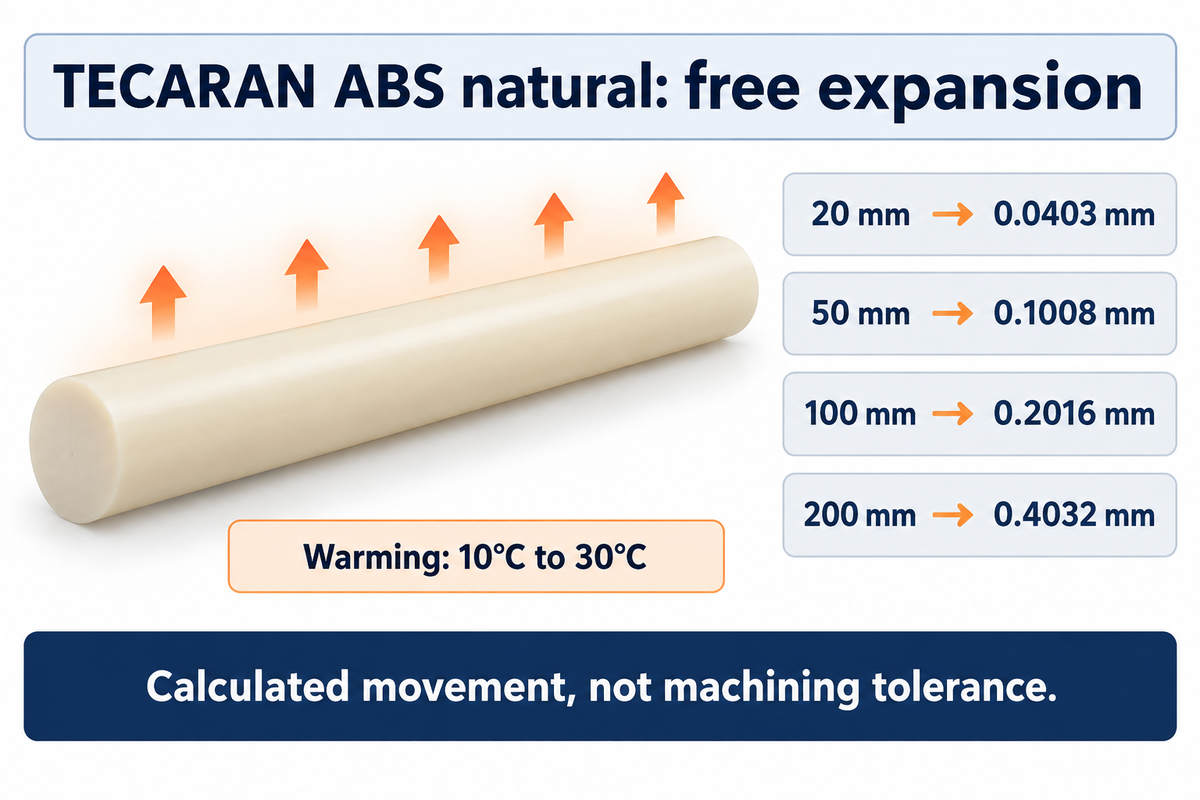
Calculation inputs: uniform, unconstrained TECARAN ABS natural; warming from 10°C to 30°C; supplier coefficient of thermal expansion (CLTE) of 5.6 × 10⁻⁵ in/in/°F, published over −40°F to 100°F. The 20°C change equals 36°F, and both endpoints are inside that interval.
Free expansion = initial length × CLTE × temperature change.
A 100 mm dimension would give a calculated value of 0.2016 mm.
| Initial dimension | Calculated free growth, 10–30°C |
|---|---|
| 20 mm | 0.0403 mm |
| 50 mm | 0.1008 mm |
| 100 mm | 0.2016 mm |
| 200 mm | 0.4032 mm |
This analysis accounts for thermal movement; it isn’t for machining tolerances or predicting assembly clearances. Fasteners, other materials’ expansion and uneven heating, and other factors can change the assembled result. Define inspection conditions based on drawing tolerances for mating features.
What are the downsides of ABS plastic?
It has a limited sustained-load temperature capability and is affected by some solvents and sunlight-induced aging. The formulation of the material also affects its thermal stability. If a close fit over the expected range of temperatures is required, it’s recommended to perform expansion calculations and evaluate the load history before choosing ABS.
Benefits of ABS plastic for an enclosure and other parts
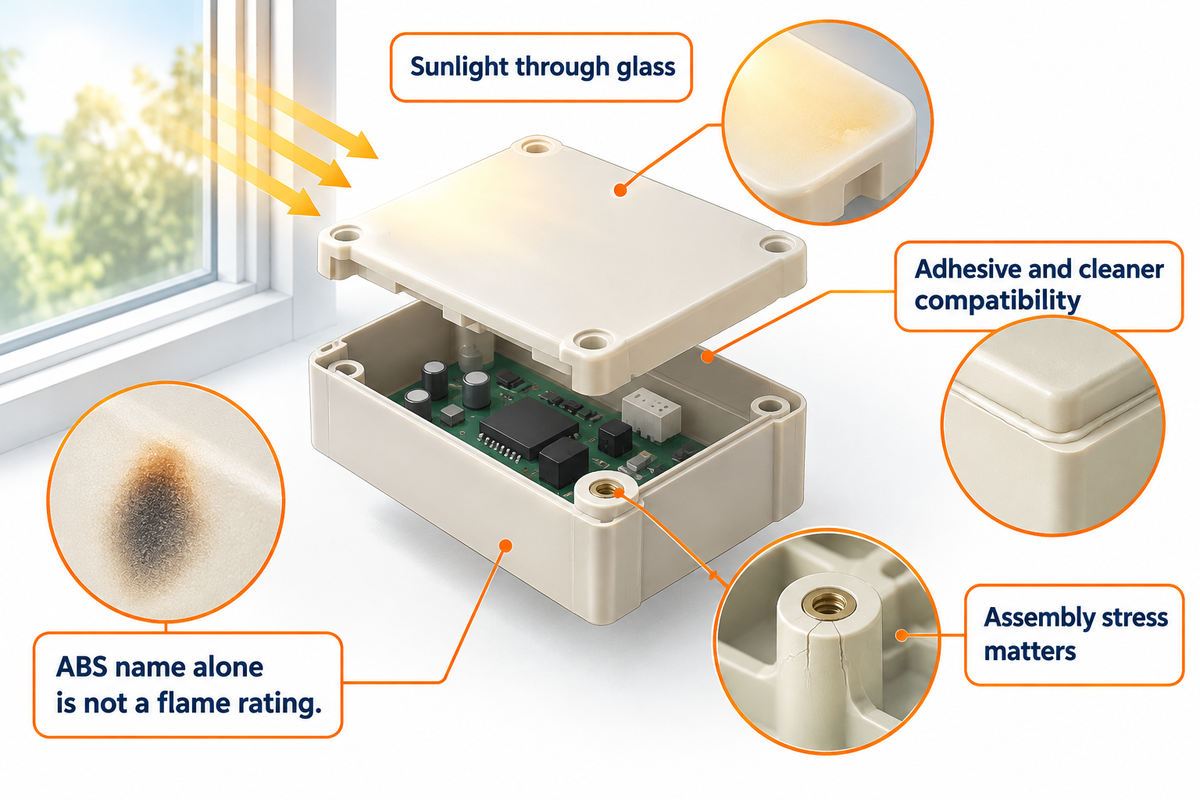
ABS has many advantages for indoor covers, handles, and prototype housings. Common uses include prototype housings, automotive interior trim and electrical and electronic housings. For quick prototypes, the advantages of ABS include solid stock forms and features that can be cut directly from a drawing.
Housing prototypes, with connector cutouts and removable lids, can be easily changed with CNC. It can also be machined to size, but a glossy surface finish may be required to meet a specification, especially if it’s for a display. A good example is a display housing next to a window, which can age under sunlight even when placed indoors.
Electrical insulation properties can assist in designing a housing, but electrical properties and fire behavior depend on the formulation and finished assembly. Additive packages can significantly change performance. ABS designation alone shouldn’t be used to choose a flame-rated enclosure or medical device components.
ABS plastic parts can remain susceptible to degradation indoors, as in Fiorio and colleagues’ 2020 ABS aging study, where they simulated sunlight through glass and reported surface embrittlement and yellowing.
Evaluate toughness and resistance to assembly chemicals separately. Dooher and colleagues’ 2022 failure study attributed cracking in injection-molded ABS consumer parts to an ester-based lubricant or glue in combination with residual stress. For a bonded housing, evaluate the adhesive and cleaning product under the assembly stress in the intended grade.
ABS machining: 3 checks before cutting
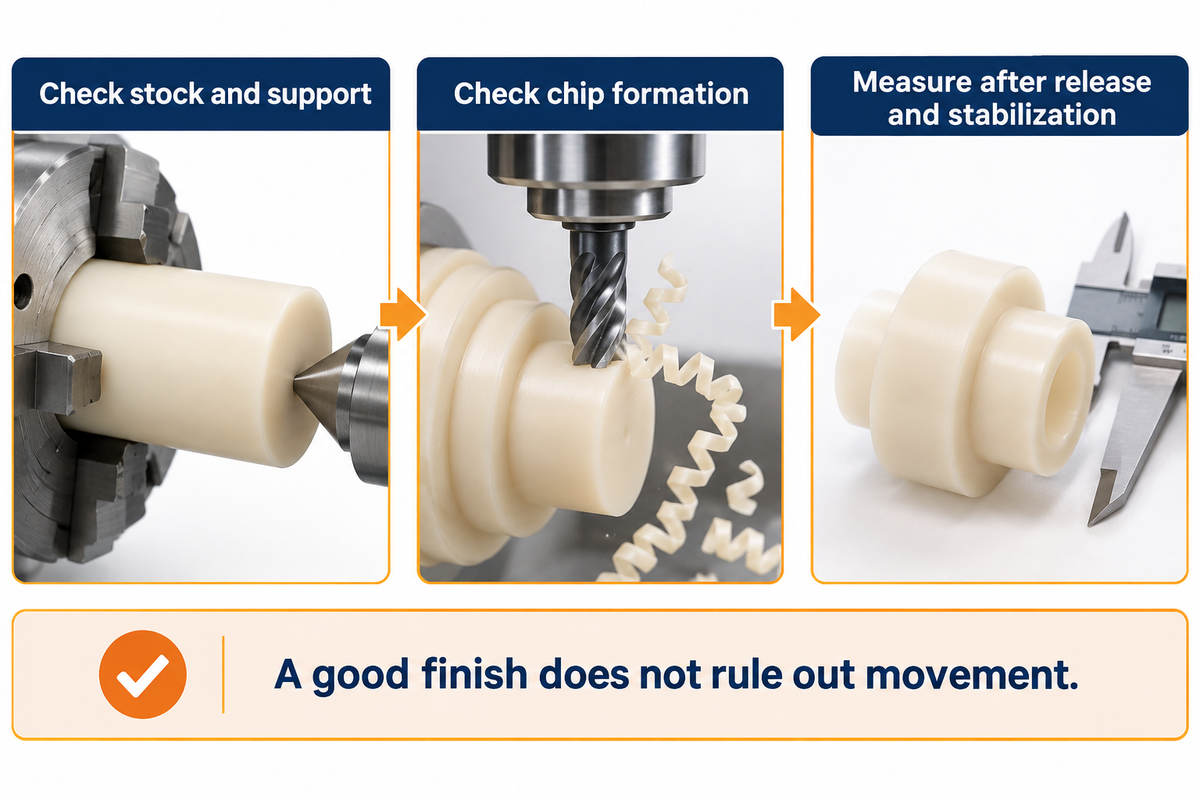
Initiate ABS machining with the stock condition. Check chip formation and the measurement state. These checks address three different reasons for a poor part, i.e. movement as the material is removed, local heating during cutting and distortion hidden by the fixture. A good surface finish doesn’t rule out movement after release.
- Check stock and support. Inspect plate flatness and allow support around thin sections. Removing substantial material from one face can release residual stress. Use the workholding guide to choose support that holds the blank without visibly bending it.
- Check the chip before slowing the feed. Start with a sharp cutter with suitable milling cutter geometry for plastic and its supplier’s recommended settings for the machine. Sticky chips or smeared edges call for a check of rubbing and evacuation. Slower feed can make rubbing worse when spindle speed stays high; simply reducing one number isn’t a universal cure.
- Check after release and stabilization. Measure critical dimensions after removing clamp loads and allowing the part to reach the specified inspection temperature. If a thin wall moves, separate fixture distortion from thermal movement before changing the programmed dimension.
A Practical Machinist discussion shows why someone with routing experience gives different advice than someone with rigid-milling experience. Take such accounts as process clues. Don’t treat such reports as a transferable parameter chart. For detailed process guidance, refer to Zhenling’s ABS CNC machining process guide, which describes the process from stock review to inspection.
ABS vs acrylic, polycarbonate and other plastics
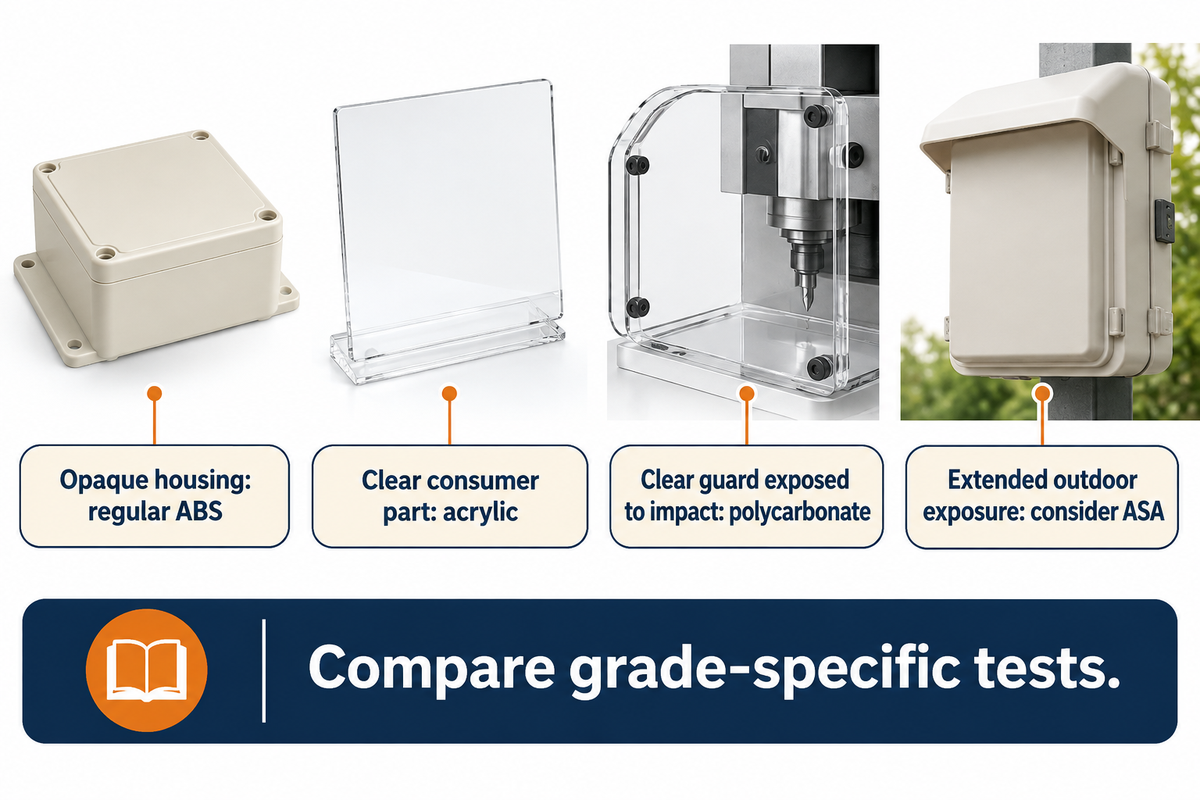
For a rigid opaque housing, if machinability and impact tolerance suit the requirement, use regular ABS. For clear consumer parts, consider polycarbonate. For parts which have to withstand outdoor conditions for extended periods of time, consider ASA over regular ABS.
What are the key differences between ABS plastic and acrylic plastic?
For housing, opaque regular ABS is a common choice. For transparent consumer parts, use clear acrylic. Consider polycarbonate for a clear guard which is exposed to impact. For each of these, compare grade-specific tests.
Formerra’s ASA material overview highlights its weatherability focused rubber technology. Javier Cruz’s material-selection guidance cites ASA and PMMA as materials that can withstand UV exposure. Outdoor applications still involve moisture, chemicals and thermal cycling; weather resistance alone doesn’t solve the design.
Polypropylene and polyethylene can be considered for material selection if chemical contact drives the decision, but their stiffness and joint requirements need to be assessed again. Avoid stating any of these plastics resists all chemicals without stating the fluid, its concentration and temperature. An alkali solution, a detergent and a solvent are different cases.
Compare complete quotations for the same drawing and inspection requirements. A less expensive stock material can lose its advantage if the replacement requires thicker walls, a different joining method or additional finishing. Look at the machining materials hub if the required properties rule against ABS.
ABS sheet and rod: choosing stock and a supplier
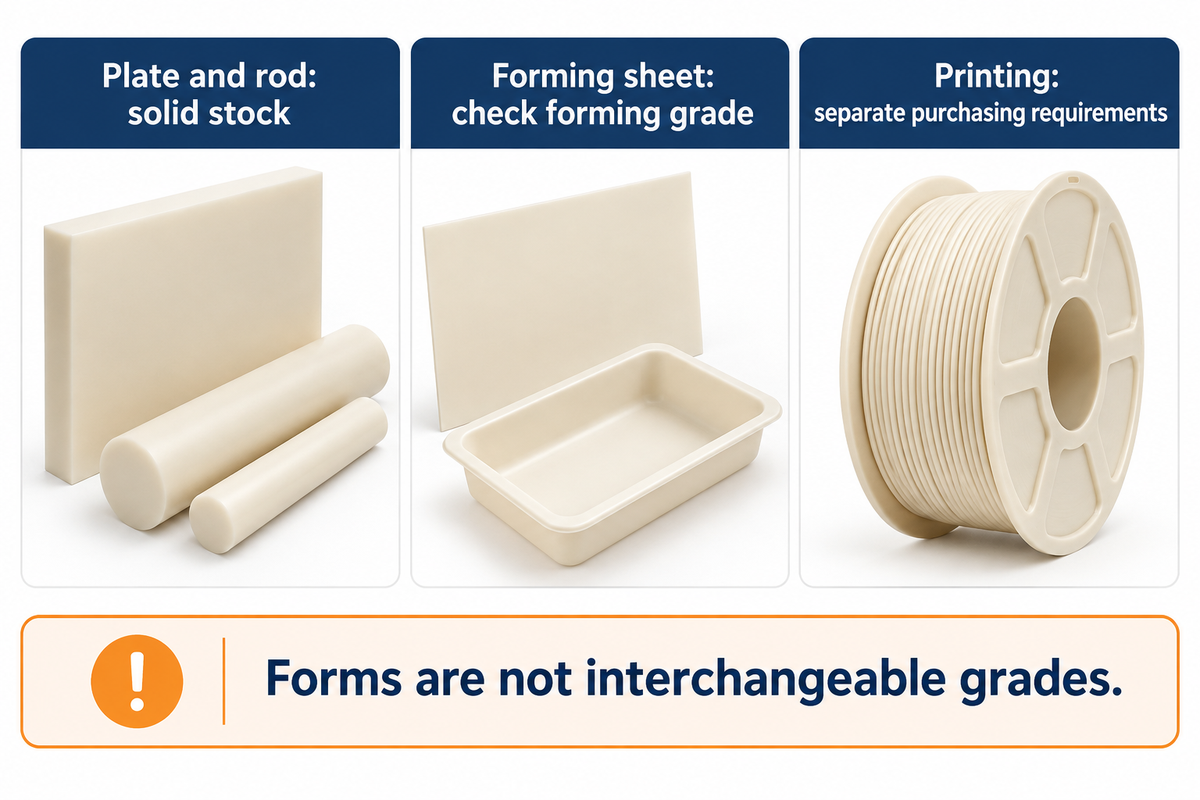
Purchase ABS sheet or rod against the finished geometry, grade and available stock dimensions. Material for 3D printers has different purchasing requirements from solid stock.
The following labels describe different forms or different formulations. They aren’t interchangeable grades and don’t represent stock held by Zhenling.
| Ordering label | Typical purchasing purpose | Detail to settle |
|---|---|---|
| Solid ABS plate | Pockets, covers and machined panels | Usable thickness, flatness and finish allowance |
| ABS rod | Turned spacers, plugs and round features | Usable diameter, straightness and grade |
| Thermoforming ABS plastic sheet | Heated and formed shells | Texture, thickness distribution and forming grade |
| ABS molding resin | Injection-molded parts | Resin designation and molding requirements |
| ABS filament | Material-extrusion printing | Printer process and printed orientation |
| ABS-like photopolymer | Vat-photopolymerized prototypes | Resin identity and cured-part properties |
| PC/ABS blend | Applications requiring a different property balance | Blend grade, process and relevant property data |
| Flame-retardant ABS grade | Parts with a specified flammability requirement | Exact designation, color and applicable thickness |
| Recycled-content ABS grade | Parts with a defined recycled-content requirement | Named formulation, traceability and property specification |
For an ABS plastic sheet quotation, state finished dimensions, quantity, color, cosmetic faces and critical mating surfaces. Also give expected temperature range and contact chemicals in the inquiry. If offered a substitute grade, evaluate its data against requirements to be sure it’s suitable.
ASTM D4673-23 presents a classification system for ABS molding and extrusion materials. This system describes materials and serves to classify materials for the purpose of specifying, rather than selecting materials. An engineering drawing and its material grade callout need to reflect the part design and required performance. The drawing must also describe function.
ABS machining cost: stock, setup and quantity
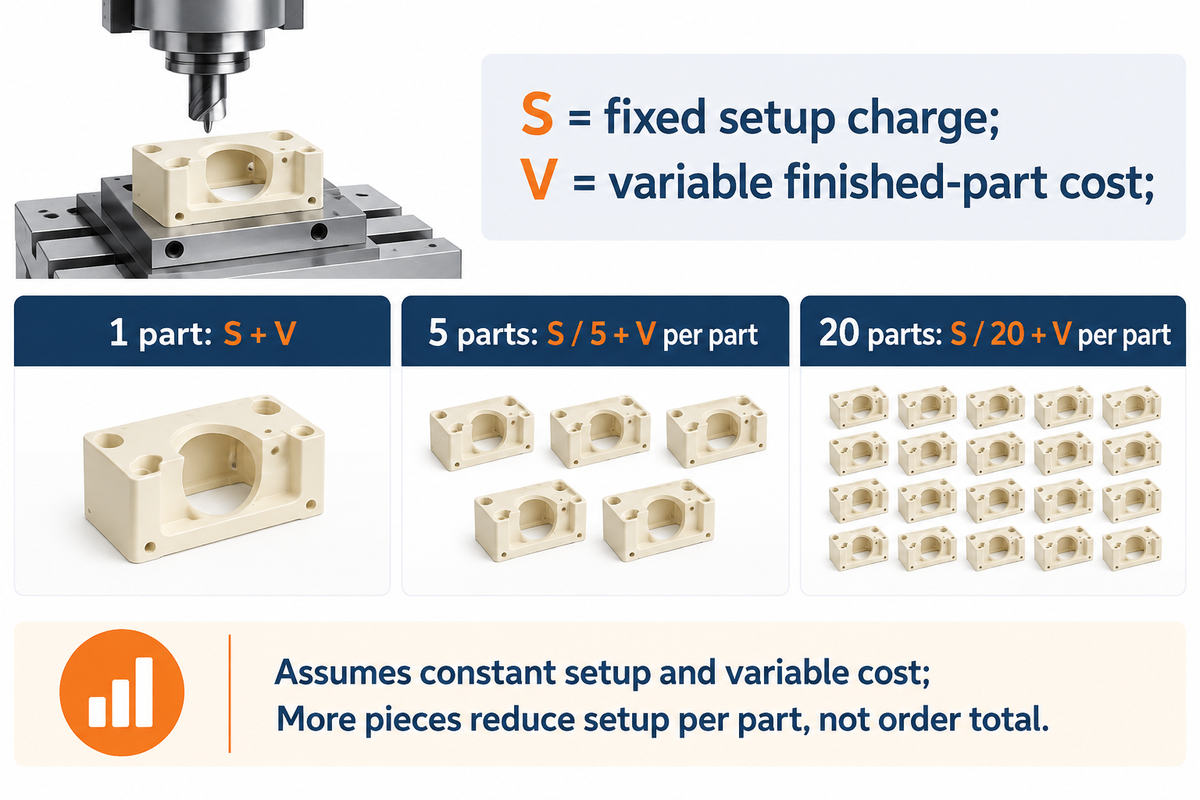
The price of a machined ABS prototype includes stock, programming and set up, cutting time, finishing and inspection. Quantity spreads the fixed work over more pieces. Compare quotes for the same drawing revision. A low sheet price says little about the cost of a finished housing with several set ups.
Quote inputs: Ask for the fixed set up charge, S, and the variable cost of a finished part, V, for the same drawing. The comparison assumes those inputs remain constant with quantity. Confirm any quantity-dependent changes in material or cycle time with the supplier.
| Quantity | Setup allocation per part | Unit cost | Order total |
|---|---|---|---|
| 1 part | S | S + V | S + V |
| 5 parts | S / 5 | S / 5 + V | S + 5V |
| 20 parts | S / 20 | S / 20 + V | S + 20V |
A higher quantity reduces the fixed set up charge per piece, but increases the total cost. If the design is likely to change, a small first batch can save the cost of unneeded inventory. Actual prices vary with the drawing, material and process; obtain a quotation for the intended order quantity.
Identify critical tolerances and finishes before requesting prices. A critical fit may require a finishing set up and inspection; a non-functional outer face may not. Mark both clearly to suppliers.
Send the drawing and preferred material designation for the required quantity through the ABS Part enquiry page. Include mating dimensions to help address scope of the quotation.
ABS plastic questions
Can ABS plastic be repaired?
Yes, in some cases: certain cracks in ABS parts can be repaired with an appropriate adhesive or a plastic-repair process. Depending on the crack location and the type of load on the joint, a cosmetic cover or a stressed mounting boss may require a different decision. Make sure you follow the repair-product instructions. Some materials are solvent-sensitive and can crack further when a chosen bonding system attacks the material under stress.
Is ABS plastic recyclable?
Yes, ABS is a thermoplastic that can be mechanically recycled. However, collection and acceptance of recyclables vary from place to place. It’s recommended that similar scraps be kept separate. E.g. keep clean machining offcuts separated from mixed plastics, coatings and adhesive scraps. A recycler must be aware of the material stream. For a new part made with recycled content, using a named grade for the desired property is recommended. Repeated recycling, contamination and formulation changes can affect the performance of a grade.
Can ABS plastic be heated and bent?
Yes, ABS sheet can be formed or shaped. One thermoforming guide heats the sheet to typically around 300-350°F (150-177°C) for forming, depending on the material thickness. Heating and cooling should be done as per the grade’s manufacturer’s recommendations. The long term service temperature mentioned in a stock datasheet isn’t the forming temperature. Several factors, such as thickness of the sheet, the bend radius, and support affect forming. Reheating can move mating surfaces and shift the position of holes on a previously machined (finished) part. If forming is required on a finished part, complete the forming prior to final dimension checks where the process allows.
Is ABS plastic suitable for outdoor use?
Usually not for long-term sun exposure: general-purpose ABS can age under sunlight, so weatherable ASA deserves comparison for longer-term outdoor exposure. Using a UV-stabilized grade of ABS can change the decision. If exposure is combined with mechanical loads, heat and moisture, these conditions also affect the material decision.
Is ABS plastic non-toxic?
Food contact and medical devices need an ABS grade selected for that use, not just any ABS. These require a formulation and finished product evaluated for the specific contact conditions. For handling and processing, use the supplier’s safety data and equipment recommendations. Heating, combustion and exposure to machining dust require controls different from ordinary contact with a finished housing. Treat ABS as a combustible material and check specified product documentation for its fire performance.
What dissolves ABS plastic?
Some solvents, including acetone, can attack ABS. Don’t use solvent attack as a cleaning shortcut on a finished part; the surface may soften, craze or crack under stress. Use a cleaner recommended for the grade and for the application.
Is ABS plastic better than PVC?
Neither ABS nor PVC is universally better. ABS is often considered for impact-tolerant housings and machined prototypes. PVC has other formulations with different service limitations. Compare the specified grades for chemical contact, temperature, joining method, and stiffness. If the component must match an existing assembly, changing polymer also changes the material assumptions behind the dimensions and fastening details.
Related reading
- Electronics CNC machining: controlling housing interfaces
- Free state vs constrained inspection
- Measurement uncertainty near a tolerance limit
- Flatness vs straightness for machined features
References & Sources
- Ensinger: TECARAN ABS natural technical details.
- Ensinger: ABS material overview.
- ASTM D648-18: public scope and significance.
- ASTM D4673-23: ABS classification scope.
- ASTM D256-26: Izod impact comparison limitations.
- Michael Sepe, 2019: Heat Deflection Temperature vs. Dynamic Mechanical Analysis.
- Javier Cruz, 2025: selecting plastic for outdoor applications.
- Dooher et al., 2022: environmental stress cracking case studies.
- Fiorio et al., 2020: UVA aging and recycling of ABS.
- Golubović et al., 2023: printed ABS and ABS-like polymer testing.