

Updated October 2026
Polyamide is a family of polymers whose chains contain amide bonds. Nylon is its best-known synthetic member. PA6 and PA66 are common engineering choices; PA11 and PA12 are good choices when consideration must be given to moisture-related movement. The exact grade and operating conditions determine the best choice.
Material essentials
- PA means polyamide; the number identifies the polymer chemistry.
- Water absorption changes both dimensions and mechanical behavior.
- Melting temperature, heat-deflection temperature and continuous service temperature answer different questions.
- A fabric label, molding compound and machined stock shape describe different products.
A drawing labeled “nylon” gives the supplier the freedom to choose among many different grades. That choice can affect a bushing’s clearance and a housing’s stiffness and the cost of fabricating an acceptable part. Start with the family, then narrow the choice to the conditions the component will face.
Polyamide meaning: where nylon fits
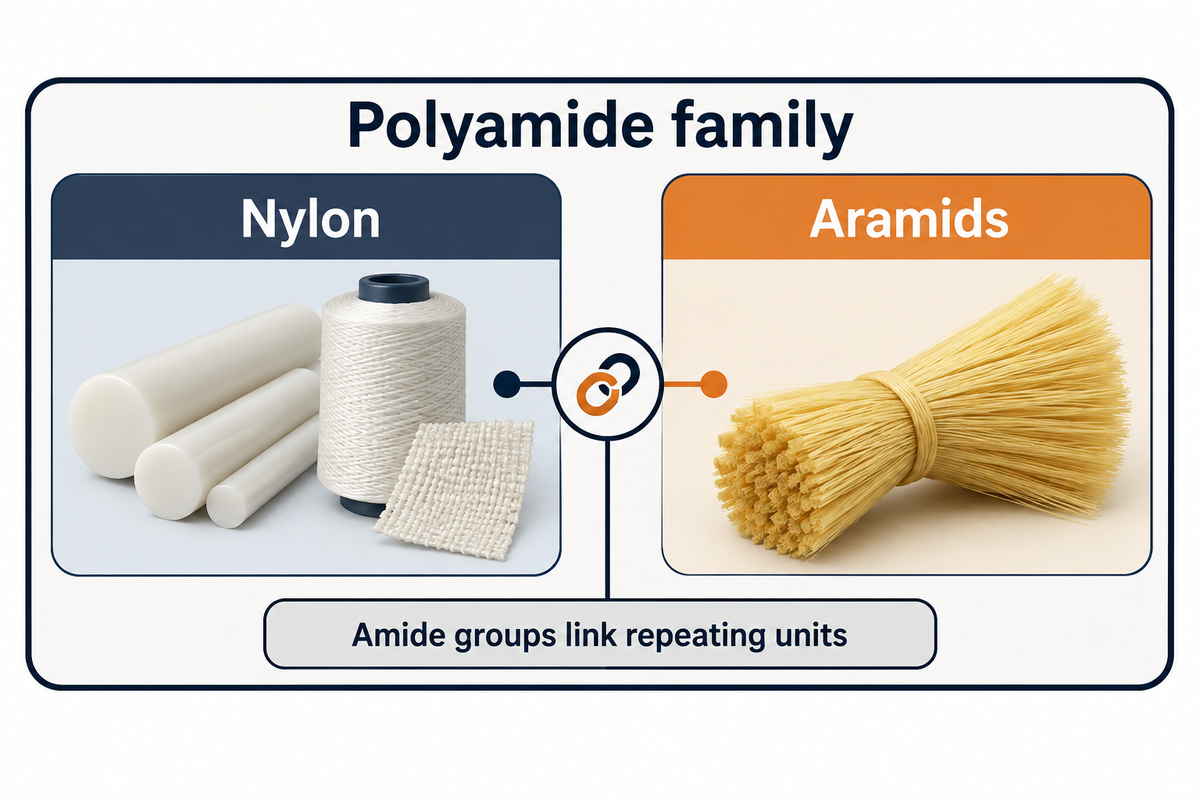
Polyamide describes molecular structure: repeating units connect through amide groups. Materials such as nylons and aromatic polyamides called aramids are included in synthetic polyamides. Proteins in wool and silk are naturally occurring polyamides. While in an engineering purchase the term polyamide is taken to mean nylon, the family name leaves the properties of the material undetermined.
Is polyamide the same as nylon?
Yes, for most clothing labels and everyday engineering references, polyamide means nylon. Chemically, nylon is a type of polyamide. Common types of nylon include PA6, PA66, PA11 and PA12. An aramid, for example, has a different backbone and behavior and, thus, the family name is broader than nylon.
The nylon designation describes the number of carbon atoms in the starting monomer. PA6 contains a six-carbon unit; PA66 is made from hexamethylene diamine and adipic acid, and its amine and acid groups react to make amide linkages. The single numbers in PA11 and PA12 identify eleven- and twelve-carbon starting units, respectively. The report by the International Union of Pure and Applied Chemistry describes the repeating units of PA6, PA11 and PA12. Knowledge of the chemistry is essential for identification, while reinforcement, additives and production history determine the grade purchased.
The common polyamide known as nylon has aliphatic chain segments unlike the aromatic rings in aramids. Formerly DuPont brands, Arclin’s Kevlar and Nomex are familiar aramid names, but their fiber applications differ from those of a machined PA66 bearing. “High-performance” implies suitability for a particular job, and that job may differ from a bearing’s job.
Nylon 6, 66, 11 and 12: choosing a starting material
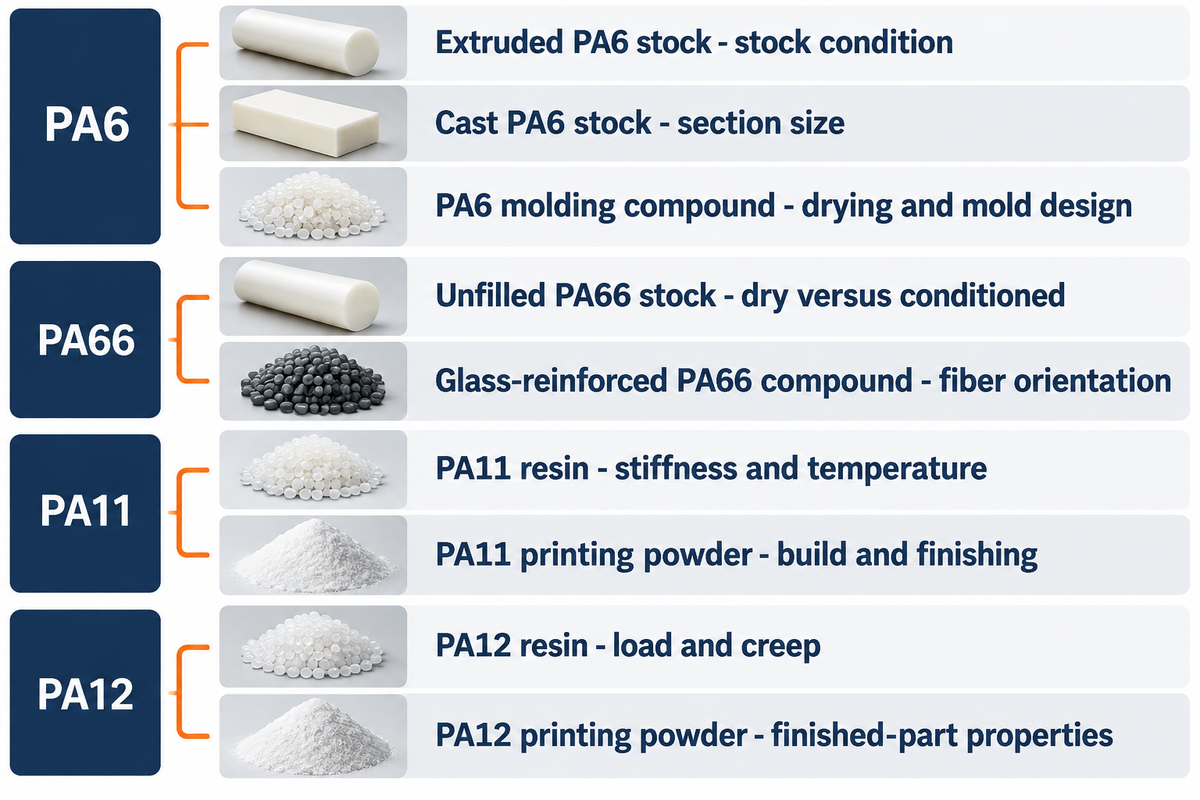
Shortlist PA6 or PA66 for conventional machined wear components, then consider PA11 or PA12 when moisture response or flexibility changes the choice. However, consider PA11 or PA12 if flexibility or low moisture absorption is required. Ensinger supplies engineering nylon stock; Arkema describes PA11’s moisture behavior, and Evonik describes low absorption for VESTAMID L PA12. Compare the actual grade at its working temperature and moisture state.
Grade-to-Service Match
In the nylon family, the manufacturing form is matched to the load, environmental conditions and the state of inspection of the finished part.
Use the matrix to eliminate possibilities before ordering material. A polymer name may be shared by a reinforced compound and a printing powder, despite their different production processes. The next specification determines the decision.
| Candidate | Useful starting point | Decision-changing detail |
|---|---|---|
| Extruded PA6 stock | Machined guides and wear components | Stock condition and critical dimensions |
| Cast PA6 stock | Larger machined shapes and rollers | Section size and the selected cast grade |
| PA6 molding compound | Repeated molded geometry | Compound identity, drying and mold design |
| Unfilled PA66 stock | Machined parts needing the grade’s wear and mechanical balance | Dry versus conditioned properties |
| Glass-reinforced PA66 compound | Parts where stiffness drives selection | Fiber content, orientation and surface requirements |
| PA11 resin | Flexible components or moisture-sensitive applications | Exact stiffness and temperature requirement |
| PA11 printing powder | Powder-bed parts with a qualified material/process pairing | Build settings, orientation and finishing |
| PA12 resin | Low-absorption candidates for stable fit | Load, creep and chemical exposure |
| PA12 printing powder | Complex printed housings and functional prototypes | Powder specification and finished-part properties |
Imagine a design change where a metal guide is replaced by a part from nylon in a humid environment. A stock shape is quicker to purchase, but a sufficiently stiff part must also hold the guide in position. PA12 needs to be considered, among others, due to low water absorption, but the same part also needs to withstand the load without unacceptable deflection. The PA12 part can be increased in thickness to reduce deflection, but that also alters the outcome. A different grade of PA12 can be used. Consider dimensional change and deflection for each part, and keep in mind that a resin selected only based on its absorption may not answer the load-bearing question, even if its dimensions change less due to moisture absorption.
Polyamide properties: read the test conditions first
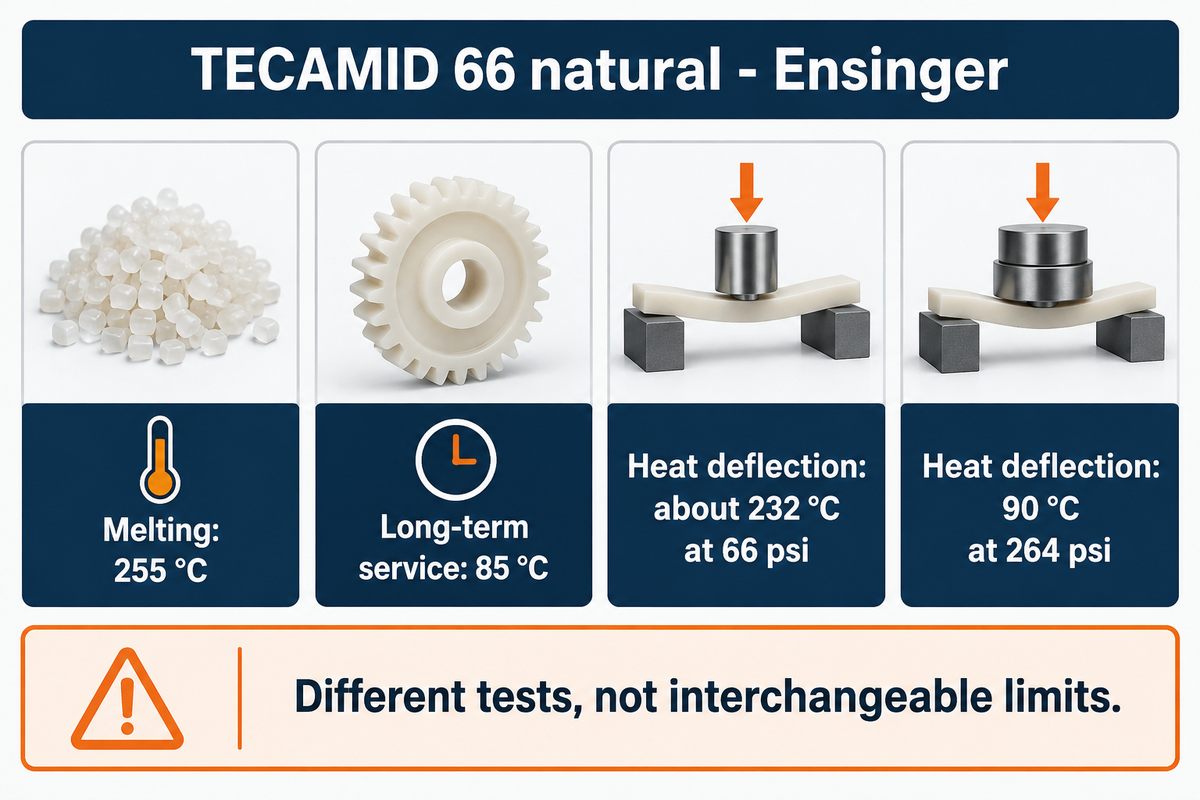
Nylon mechanical properties depend on variables such as moisture and the conditions of the test. For TECAMID 66 natural, Ensinger publishes distinct melting, service and deflection temperatures. The table below differentiates the three. At high temperatures, a part can lose useful stiffness well below melting, and water plasticization changes the temperature-dependent response as well as the room-temperature strength.
| Property | Published value | Condition or interpretation |
|---|---|---|
| Density | 1.14 g/cm³ | Named unfilled PA66 stock shape |
| Melting temperature | 491 °F (255 °C) | Material transition, not continuous duty |
| Short-term service temperature | 300 °F (about 149 °C) | Supplier’s short-term field |
| Long-term service temperature | 185 °F (85 °C) | Supplier’s long-term field |
| Heat-deflection temperature | 450 °F (about 232 °C) | 66 psi load; ASTM D648 |
| Heat-deflection temperature | 194 °F (90 °C) | 264 psi load; ASTM D648 |
| Tensile strength at yield | 12,000 psi | 73 °F; ASTM D638 |
| Tensile modulus | 350,000 psi | 73 °F; ASTM D638 |
| Water absorption | 0.45% | 24 hours at 73 °F; ASTM D570 |
| Water absorption at saturation | 8.5% | 73 °F; ASTM D570 |
Deflection temperature follows the test load: Ensinger reports 450 °F at 66 psi but 194 °F at 264 psi for the same PA66 stock under ASTM D 648. Glass fiber reinforcement can increase the stiffness, but fiber orientation adds a dimension to the comparison. Processing history and degree of crystallinity also affect how a nylon component behaves.
ASTM D618-21 standardizes conditioning for comparable plastic tests. The procedures are designed for reproducibility, although they may not bring a specimen to equilibrium. That distinction is important when a part passes incoming inspection and is then put in storage for months in different humidity conditions.
“Time to saturation is strongly dependent on specimen thickness.”
Wetzel and colleagues’ 2023 PA66 study showed that absorbed water moved the glass-transition range and reduced the stiffness and strength of the material. Therefore, moisture and temperature should be described together in an operating condition. A dry-state strength figure paired with an unrelated wet-state allowance can misrepresent the finished part.
Moisture absorption: why a nylon part can change size
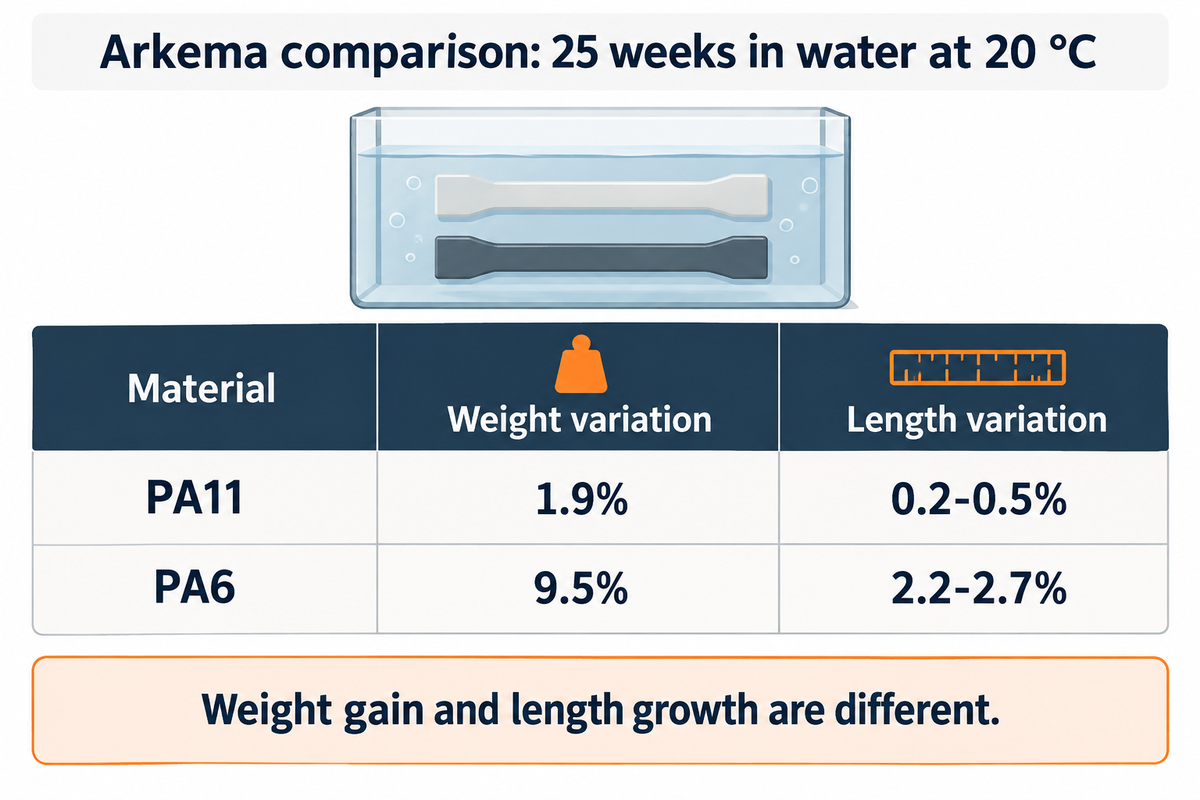
The evolution of dimensions over time for a polymer is related to absorption of moisture. Arkema’s PA11-versus-PA6 comparison reports both weight gain and length growth after prolonged immersion, while ASTM D570 describes how exposure and specimen geometry affect absorption. A dimensional estimate requires a length measurement and the related conditions.
| Material | Weight variation | Length variation |
|---|---|---|
| PA11 | 1.9% | 0.2–0.5% |
| PA6 | 9.5% | 2.2–2.7% |
Example: take a hypothetical 100 mm reference length and apply the published PA11 length range under the comparison’s immersion conditions. The arithmetic is 100 mm × 0.002 = 0.2 mm and 100 mm × 0.005 = 0.5 mm. Applying the PA6 length range gives 2.2–2.7 mm. These calculations show the scale of the reported length percentages; they aren’t bore-clearance allowances. Actual growth also follows the grade, geometry and measured direction. In Wetzel’s injection-molded PA66 specimens, thickness expanded more than the in-plane dimensions, so an isotropic assumption would miss a measured difference.
Is polyamide waterproof?
No, ordinary nylon retains moisture, even if the final product is water-resistant: Ensinger’s data sheet for an unfilled nylon stock shape lists 8.5% moisture absorption at saturation, 73 °F. Coated polyamide fabric can shed rain, but its polymer fibers will still respond to humidity. For solid pieces, wall thickness and exposure time impact absorption. Water resistance of an assembly, dimensional stability of a component and moisture uptake of the resin are separate properties.
For a tight fitting component, a drawing needs a measurement state along with the size. Support and clamping can also move a flexible part during measurement; the difference between free-state and constrained inspection can help differentiate material movement from fixture-induced movement.
Polyamide vs polyester: fabric and engineering plastics
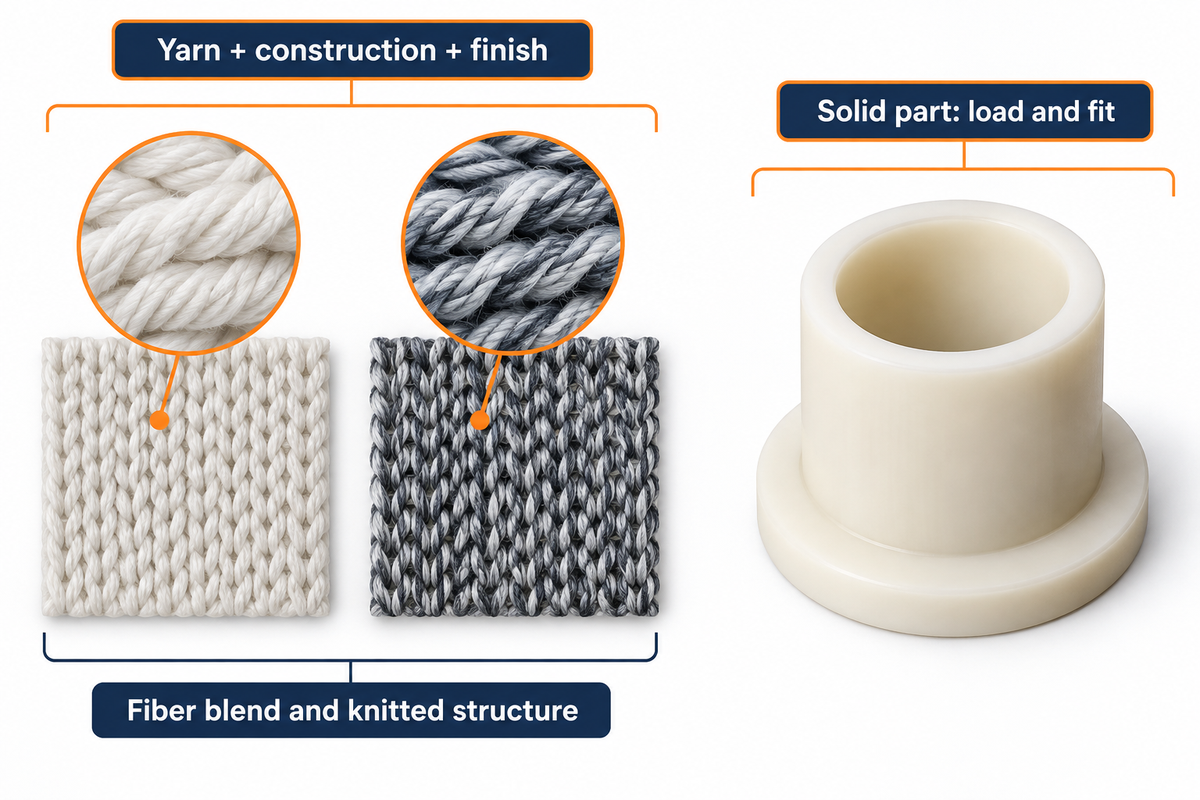
Polyamide fabric and polyester fabric differ in polymer chemistry, but garment performance also follows yarn, construction and finish. Amide bonds identify the nylon family; polyester uses ester links. A sportswear blend with elastane gains stretch from both its fiber blend and knitted structure. These types of plastics need a different comparison in solid parts, based on load and fit.
Garments can’t be ranked for softness, elasticity and abrasion resistance from nylon content alone. A dense woven shell and an open knit behave differently even if they use the same synthetic polymer. Construction differences define types of fabrics. Solid polyamide materials differ by grade and form. Both nylon and polyester appear in sportswear, linings and outer layers. The apparel maker, Olaben, describes nylon as generally softer and more elastic, and polyester as often quicker-drying. Use these descriptions as starting points for garments, then compare actual weight, knit and finish.
Post-use considerations also include composition. One example in Nilit’s published PA66 textile application describes textured yarn to help achieve elasticity without high-elastic components of another polymer. This example illustrates a design route aimed toward easier material recycling. A mixed fiber sports garment and a single polymer industrial offcut present other sorting and recycling challenges.
Is polyamide itchy or comfortable against skin?
Polyamide can feel smooth against skin; the polymer name doesn’t specify a scratchy texture. Apparel makers use nylon in soft linings and next-to-skin garments. Comfort still follows the finished fabric, seams and fit. A fiber label alone doesn’t establish that a garment will suit every wearer or feel comfortable in every climate.
Polyamide manufacturing: machining, molding and powder printing
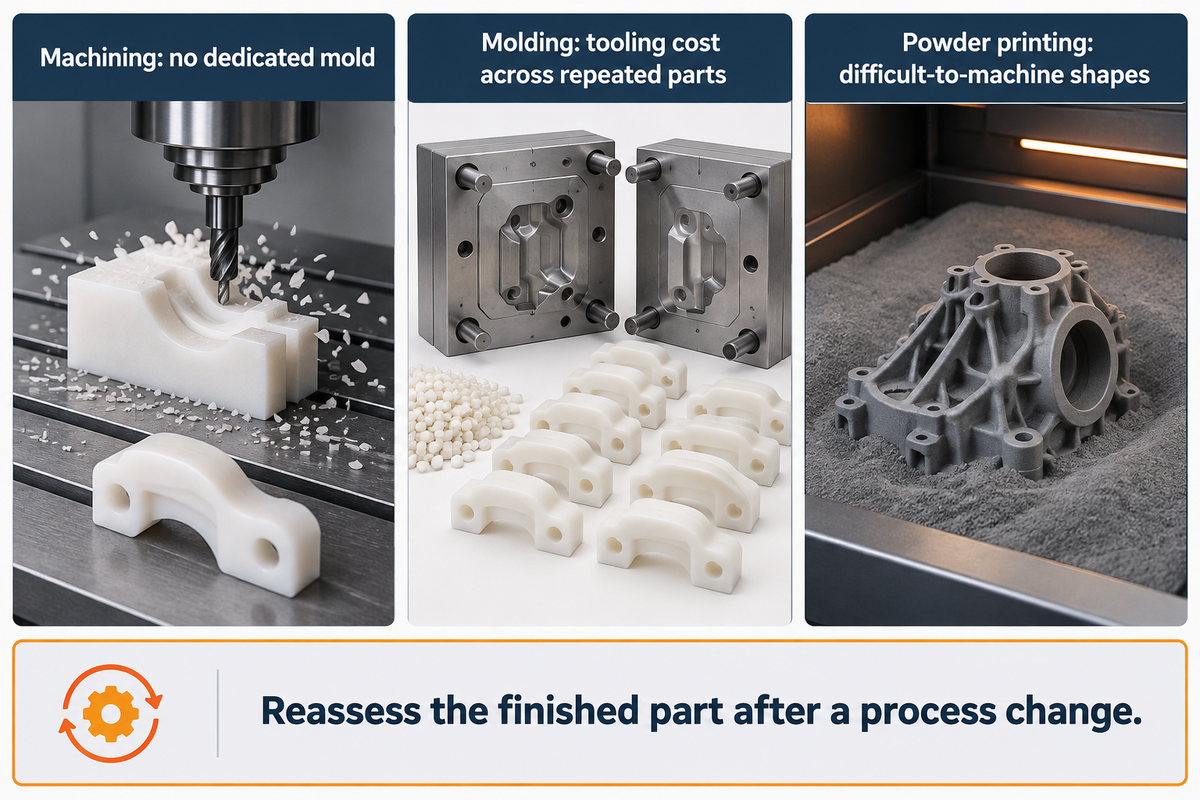
Nylon parts can be made by machining from stock, by injection molding from a compound, or by powder printing. Each of the methods yields a different history and geometry of the material. Machining lends itself to drawing-led work where no dedicated mold is required; molding spreads tooling cost across repeated parts; powder printing permits fabrication of shapes that are difficult to machine.
Nylon 6 and nylon 66 are common grades of nylon in stock and molded shapes. Nylon 11 and nylon 12 are also found in powder-bed processes like selective laser sintering. Even where resin, powder, and finished stock share a common polymer family, buying requirements differ. Process changes mandate an assessment of finished parts.
What happens if a buyer requests a machined housing and then later on wishes to have that housing molded in large quantity? The original drawing is still relevant, but the material entry has to indicate a molding compound. Gates, wall transitions and reinforcement orientation can affect the final part geometry. The quality team needs to agree on a conditioning state before comparing the molded housing against the machined prototype. A prototype that fits addresses initial fit; repeated production followed by prolonged storage addresses fit consistency over time. The same family label can conceal a process difference. The decision on the process to be used should include the fit after the intended environmental exposure, together with the tooling quotation.
The molding overview in UC Davis Tech Foundry describes some costs associated with mold development and machine-specific materials. Its manual machine excludes nylon, despite nylon being among the facility’s other material options. Capability of the equipment must be evaluated with the resin choice.
For explanation of various cutting methods, see machining processes explained. The main site’s nylon machining service covers enquiries led by drawing for made-to-print parts.
Polyamide cost: compare the finished part, not just resin
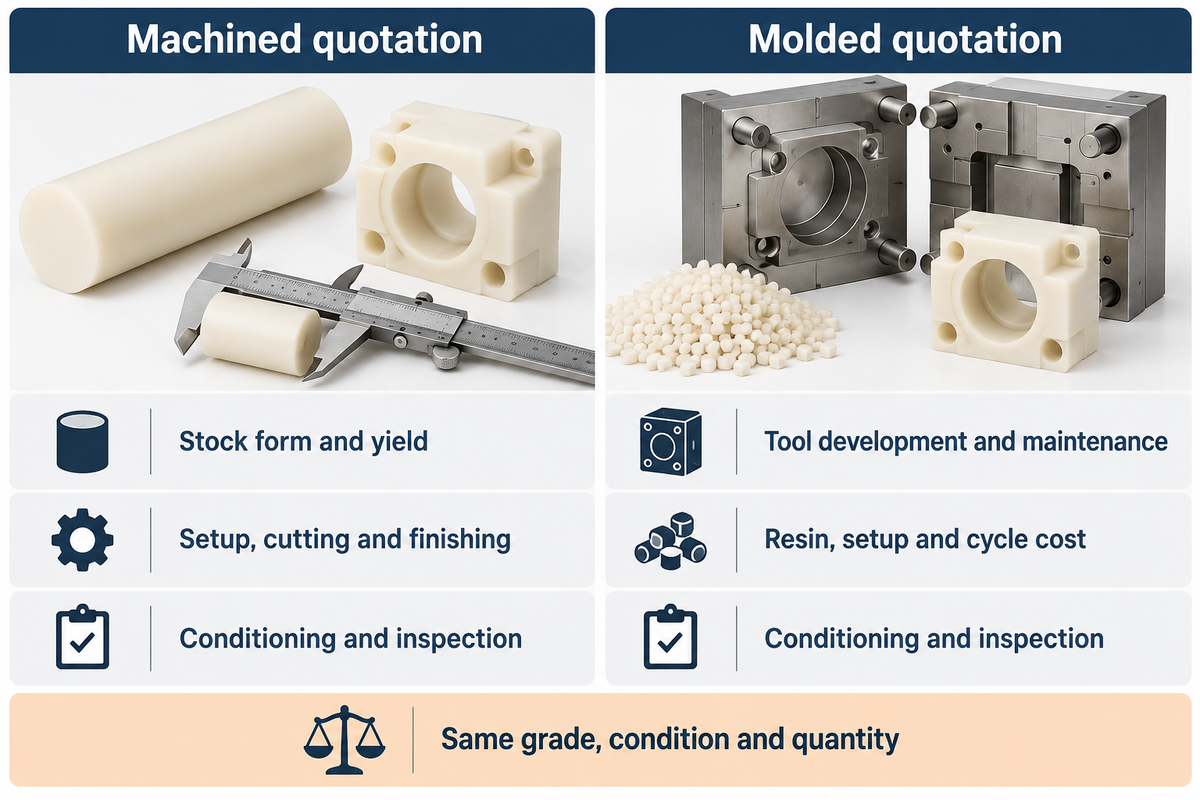
The cost of a finished part is made up of the cost of the material, the cost of processing and the cost of acceptance. The cost of processing can outweigh the savings from a lower resin price. For machining, the purchased stock size and removed material matter; tooling adds an upfront cost for molding. Make sure to compare quotations for the same condition, grade and quantity.
UC Davis separates material charges from staff time and mold development in its service description. Finance needs the cost per accepted component. Production needs a route that accomplishes the required fit.
Machined quotation
- Purchased stock form and yield
- Setup, cutting and finishing time
- Conditioning and dimensional inspection
Molded quotation
- Tool development and maintenance scope
- Resin, setup and recurring cycle cost
- Conditioning and dimensional inspection
A quoted saving is useful only after the compared orders have the same obligations. Deburring, packaging and inspection costs need to be compared if the drawing or purchase order stipulates them. Product verification can employ first-article and first-piece inspection. Each inspection has a different intent and can create different documentation costs.
Nylon purchase checklist: grade, service and inspection
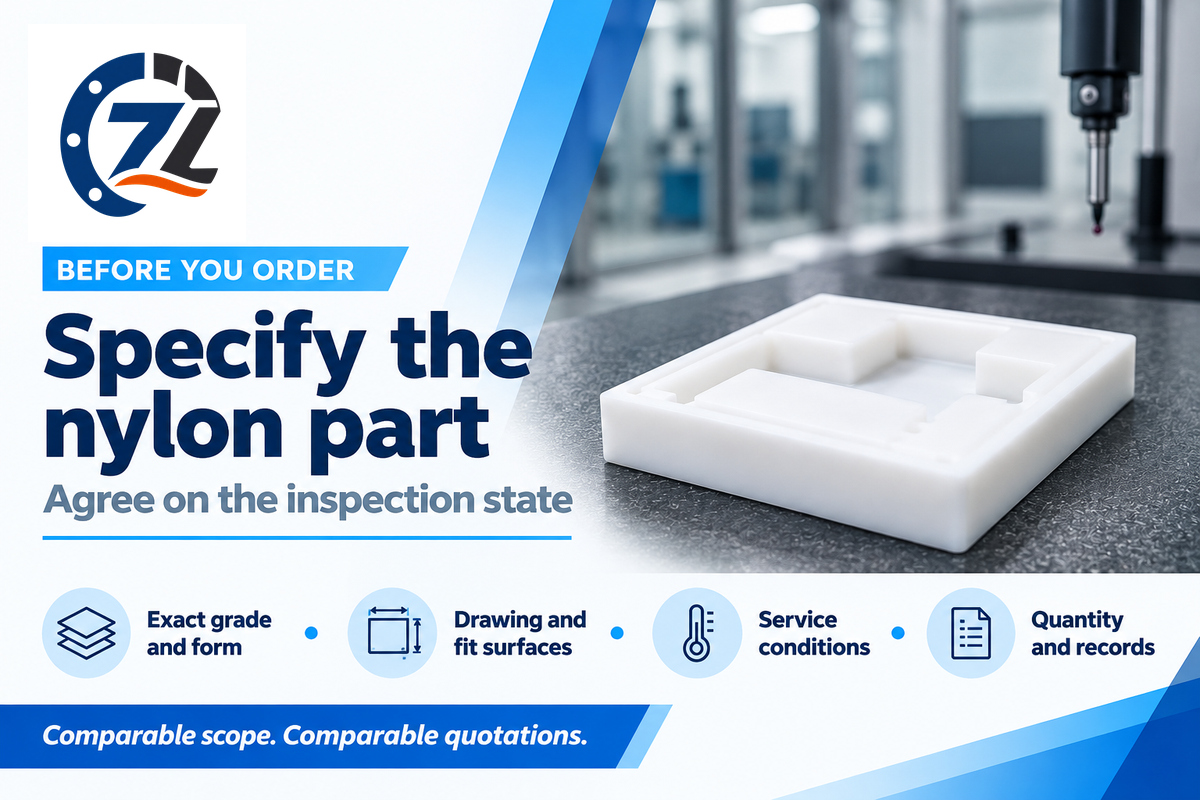
A useful nylon inquiry identifies the material grade, the form in which the material is processed, the operating environment and the state of acceptance. The designer owns the fit and load requirements. Purchasing keeps quotations comparable. Quality defines the means for measurement of the dimensions. Stipulating the above items together prevents acceptance of a dry state result for a component which is expected to work after exposure to moisture.
To illustrate an example of a machined PA66 part, the buyer should name the proposed unfilled grade, enclose the released drawing and identify the sliding surface. The service description must address humidity, temperature and the contact with fluids. Quality confirms whether the inspection is done as delivered or following a defined conditioning procedure, along with the support arrangement. Purchasing assesses each offer against this description. Should a supplier state that conditioning is included in the offer and a second supplier state a dry inspection is included in the offer, then the offered prices cover different services. Resolve this before placing the order; don’t assume two passing reports are equivalent.
Include in the enquiry
- Exact grade, filler and stock or compound form
- Drawing revision and critical fit surfaces
- Service environment and inspection condition
- Quantity, finishing and required records
Resolve before ordering
- A quotation that says only “nylon”
- A process change without grade agreement
- A tolerance with no measurement state
- A recycling claim with no specified material stream
Where discrepancies occur in reports, verify the setup and material state and consider the effects of alignment and temperature and support. Why coordinate-measuring results differ explains these effects.
Frequently asked questions
Is polyamide a plastic?
Yes, the synthetic nylons used for molded and machined parts are plastics. Polyamide also names a broader chemical family that includes natural polymers. Silk and wool contain proteins with amide linkages. For a component order, specify the manufactured grade rather than relying on the family name to define stiffness, durability or moisture behavior.
How is polyamide made?
Polyamide is made by polymerization of suitable monomers. Common PA66 production uses condensation of adipic acid and hexamethylenediamine, a diacid and a diamine whose acid and amine groups form amide links. Nylon 6 commonly starts with caprolactam. The polymer is then processed into resin, stock shapes, yarn or other products for its intended use.
Does polyamide stretch?
Yes, nylon fibers can stretch, and fabric construction changes how much a garment stretches and recovers. Elastane blends add another elastic component. A solid engineering grade behaves differently under load, so clothing stretch isn’t a measure of component stiffness. Evaluate the finished material form and its loading conditions when comparing elasticity or permanent deformation.
Does polyamide shrink?
Nylon garments can shrink or distort under unsuitable heat and care conditions. Follow the garment’s care label. Solid nylon parts also change dimensions with temperature and moisture, but that movement is different from laundry shrinkage and belongs in the component’s inspection specification.
Is polyamide bad for the environment?
Yes, polyamide production, use and disposal have environmental impacts, although recycled polyamide reduces demand for some new feedstock and durability can extend product life. Collection and separation still matter: a mixed-fiber garment is a different recycling task from a clean industrial offcut. Materials made from renewable sources also require an appropriate end-of-life route; renewable origin alone doesn’t make a finished item biodegradable. Choose claims tied to the actual grade and recovery process.
Where is polyamide used?
Nylon is used in textiles, ropes, engineering components and many other products. Nylon stockings are a familiar fiber application; industrial examples include guides, rollers and housings. The chosen grade and form determine whether strength, abrasion behavior, flexibility or stable fit takes priority.
Where does polyamide come from?
Many common nylons start from petrochemical feedstocks. PA11 offers a different route: Arkema describes Rilsan PA11 chemistry derived from castor oil through an amino-11 monomer. Recycled feedstock supplies another route for selected grades. These origins describe the starting material, while additives, processing and product design determine the finished properties. Natural fibers such as wool belong to a different supply chain even though their proteins also contain amide bonds.
For a made-to-print nylon part, send Zhenling Metal the drawing, proposed grade and agreed inspection conditions with the enquiry.
Material property values are attributed to the referenced suppliers and published study. The examples for length calculation and purchase cases are illustrative, and not based on Zhenling’s production testing.
References & Sources
- International Union of Pure and Applied Chemistry: Characterization of Polyamides 6, 11, and 12, 2004.
- ASTM International: D618-21, Conditioning Plastics for Testing, public scope.
- ASTM International: D570-22, Water Absorption of Plastics, public scope and significance.
- Wetzel et al.: Hygromechanical Behavior of Polyamide 6.6: Experiments and Modeling, Polymers, 2023.
- WO2025032570A1: Polyamide Fabrics with Improved Elasticity and Dimensional Stability, published application by Nilit Ltd, 2025.
- University of California, Davis Tech Foundry: Injection Molding, process and costing overview.